
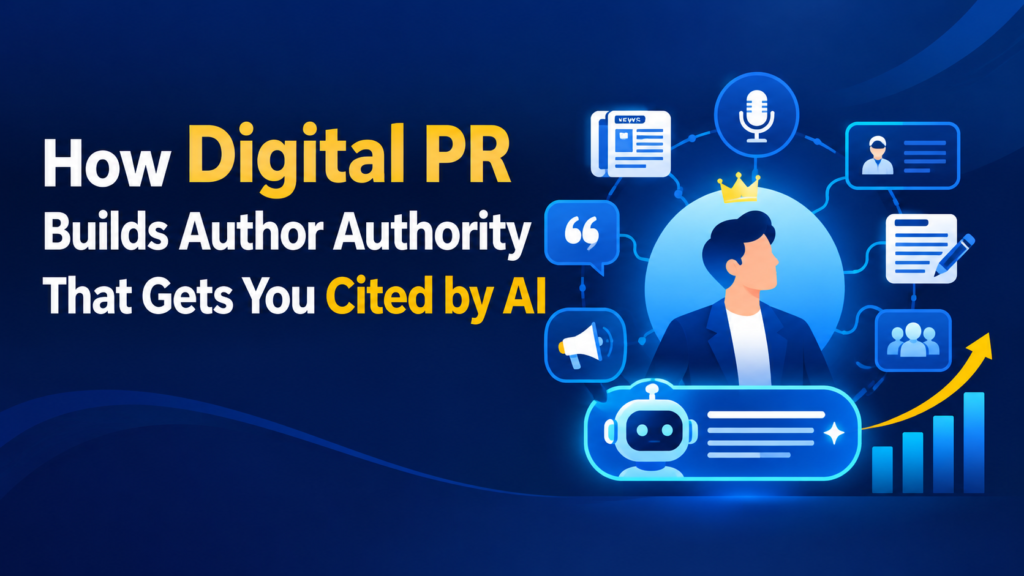
Digital PR is no longer just about earning media coverage, backlinks, or brand awareness. In the age of AI search, the right PR placements can also strengthen the signals that help large language models understand who you are, what you know, and whether your expertise is worth citing.
This matters because AI visibility depends on more than whether your website ranks in traditional search results. When systems such as ChatGPT, Google AI features, Gemini, and Perplexity generate answers, they need to identify credible entities, experts, sources, and supporting evidence.
That creates a powerful connection between digital PR and Generative Engine Optimization (GEO).
When an expert is repeatedly mentioned by reputable third-party publications, podcasts, industry websites, and expert roundups, those references can contribute to a stronger digital footprint. Over time, that footprint can make it easier for AI systems to associate the expert with a particular subject.
For marketers measuring AI visibility metrics, this means PR should be considered part of a broader AI visibility strategy rather than treated solely as a traditional SEO tactic.
What Is the Connection Between Digital PR and AI Visibility?
Digital PR involves earning attention and mentions from publications, journalists, podcasts, industry websites, newsletters, and other authoritative sources.
GEO focuses on increasing the likelihood that a brand, person, website, or piece of content is discovered, understood, and referenced by AI-powered search systems.
The two overlap because AI systems need external signals to establish context and credibility.
A website can claim that someone is an expert in a particular field. But when independent publications repeatedly identify that person as an expert, provide quotes from them, publish their contributions, or feature them in relevant discussions, the broader web contains more evidence supporting that association.
This is where digital PR author authority becomes valuable.
For example, imagine a cybersecurity consultant who publishes excellent articles about ransomware.
Their own website says:
“Jane Smith is a cybersecurity expert specializing in ransomware prevention.”
That is useful, but it is still a first-party claim.
Now imagine that Jane is also:
- Quoted by cybersecurity publications
- Featured in technology news articles
- Invited onto cybersecurity podcasts
- Included in industry expert roundups
- Published as a guest contributor
- Referenced by other industry experts
The web now contains multiple independent signals connecting Jane Smith with cybersecurity expertise.
That broader footprint can support her visibility across traditional search and AI-driven discovery.
Why Third-Party Mentions Matter for GEO
AI systems do not simply evaluate what a website says about itself.
They operate across enormous amounts of information and attempt to determine relationships between people, organizations, concepts, sources, and topics.
Third-party mentions provide additional context.
Consider the difference between these two scenarios.
Scenario 1: First-party expertise
A consultant’s website contains:
- An author bio
- A list of services
- Blog posts
- Claims of industry experience
- Testimonials
Scenario 2: First-party plus third-party authority
The same consultant has:
- A detailed author profile
- Original research
- Articles on their own website
- Quotes in respected publications
- Podcast appearances
- Industry roundup contributions
- Guest articles
- Mentions from recognized experts
The second scenario creates a much stronger network of evidence around the person’s expertise.
This is why earned media GEO can be an important component of an AI visibility strategy.
How Author Authority Works in AI Search
Author authority is not a single score that every AI system calculates in exactly the same way.
Instead, it is better understood as a collection of signals that help establish an entity’s relevance and credibility.
These signals can include:
- Consistent identity information
- Relevant expertise
- Published work
- Third-party mentions
- Expert quotations
- Industry affiliations
- Original research
- Speaking appearances
- Podcast interviews
- Guest contributions
- References from authoritative websites
The more consistently these signals point toward the same subject area, the easier it can be for search and AI systems to understand the entity.
This is particularly important for expert mentions LLM strategies.
The objective isn’t simply to get your name mentioned somewhere.
The objective is to earn contextually relevant mentions that connect your name with the topics you want to be known for.
Digital PR Can Strengthen E-E-A-T Signals
Google’s E-E-A-T framework emphasizes Experience, Expertise, Authoritativeness, and Trustworthiness.
Although E-E-A-T is not an AI citation formula, many of the activities that strengthen E-E-A-T can also improve the amount and quality of information available about an expert online.
This is why PR for E-E-A-T can complement a GEO strategy.
For example, a financial advisor who regularly contributes expert commentary to reputable financial publications creates external evidence of their expertise.
A medical writer who is interviewed by established health publications creates another layer of professional recognition.
A technology executive who appears on respected technology podcasts establishes additional associations between their identity and their area of expertise.
Digital PR therefore helps move authority beyond the company’s own website.
5 Digital PR Strategies That Can Support AI Visibility
Not every PR tactic has the same value for GEO.
The strongest opportunities are generally those that create relevant, identifiable, and context-rich references to the expert.
1. Respond to Journalist Requests
Journalist-request platforms can provide opportunities to contribute expert commentary to articles.
HARO became one of the best-known examples of this approach, while platforms such as Connectively have also been used to connect journalists with sources.
The objective should not be to answer every request.
Instead, focus on opportunities where:
- The topic directly matches your expertise
- Your contribution can add something original
- The publication is relevant to your industry
- Your name and professional identity will be clearly attributed
- The resulting article provides meaningful contextual information
A highly relevant expert quote can be more valuable for authority-building than dozens of unrelated mentions.
2. Become a Podcast Guest
Podcast appearances can generate several useful authority signals.
A quality podcast appearance can produce:
- An expert profile
- A speaker introduction
- A recorded interview
- A transcript
- Show notes
- A dedicated episode page
- Links to the expert’s website
- Social media mentions
More importantly, the discussion itself creates contextual information around the expert.
For example, if an SEO consultant appears on five respected marketing podcasts discussing AI search, those appearances collectively reinforce the association between that individual and AI search expertise.
This is particularly useful for thought leadership AI search strategies.
3. Contribute to Expert Roundups
Expert roundups are another practical PR opportunity.
A roundup might ask:
“What is the biggest mistake companies make when optimizing for AI search?”
Rather than giving a generic answer, provide a concise, distinctive perspective supported by experience or evidence.
The ideal contribution should make the expert recognizable for a specific area of knowledge.
For example:
“Most companies optimize for AI search by rewriting existing SEO content. The bigger opportunity is building evidence around the entities, experts, and original research that AI systems can independently verify.”
A strong, quotable insight is easier for journalists and publishers to use.
4. Earn Guest Bylines
Guest bylines allow experts to publish their knowledge outside their own domain.
A strategic guest-posting campaign should prioritize relevance and authority over volume.
Instead of publishing 50 generic articles on unrelated websites, aim for a smaller number of highly relevant publications.
Each byline should reinforce the same expertise.
For example:
Expert → AI search → GEO → AI citations → LLM optimization
This creates a consistent topical identity across the web.
The goal is not simply to build links.
The goal is to build recognition around the expert and their subject matter.
5. Create Data Worth Referencing
Original research can turn PR into a powerful authority-building engine.
Consider publishing:
- Industry surveys
- Original datasets
- Market research
- Benchmark reports
- Statistics
- Case studies
- Expert surveys
- Annual reports
Then use digital PR to get those findings in front of journalists and industry publishers.
When other publications reference your research, you gain something more valuable than another self-published article: independent references to original information.
That can help establish both the organization and its experts as sources worth considering.
How to Build a Digital PR Campaign for GEO
A PR campaign designed for AI visibility should begin with the topics you want to own.
Step 1: Define Your Authority Topics
Choose three to five closely related subjects.
For an AI marketing consultant, this could be:
- Generative engine optimization
- AI citations
- LLM optimization
- AI search visibility
- Digital PR for GEO
Avoid trying to establish expertise in every marketing topic.
A focused topical identity is easier to communicate consistently.
Step 2: Build Your Expert Profile
Make sure your website clearly identifies the expert.
Include:
- Full name
- Professional title
- Expertise
- Experience
- Author bio
- Published work
- Professional credentials
- Relevant achievements
- Social or professional profiles
Use the same name and professional description consistently across platforms.
Step 3: Find Relevant PR Opportunities
Build a prospect list containing:
- Journalists
- Industry publications
- Podcast hosts
- Newsletter publishers
- Roundup editors
- Conference organizers
- Relevant websites
Prioritize opportunities based on topical relevance rather than raw domain metrics.
Step 4: Create a Strong Expert Pitch
Your pitch should explain why you are qualified to comment and what unique information you can provide.
Avoid sending generic:
“I would love to contribute.”
Instead, provide a specific angle or useful insight.
Step 5: Track Your Mentions
Once coverage begins, track:
- Publication
- Date
- Topic
- Expert name
- Mention type
- Link
- Citation context
- Author bio
- Industry relevance
This gives you a structured PR dataset that can be compared with your broader AI visibility metrics.
Outreach Email Template for Digital PR
A good outreach email should be short, relevant, and centered on the publisher’s audience.
Hi [Name],
I’m reaching out because I noticed your recent coverage on [Topic], and I have a relevant perspective that could add value to your audience.
I’m [Name], a [Job Title] specializing in [Specific Area]. I’ve worked on [brief credibility point or relevant experience], with a particular focus on [Topic].
For your upcoming coverage, I can provide expert commentary on:
- [Specific insight]
- [Specific insight]
- [Specific insight]
I can also provide original examples, data, or a short expert quote if useful.
If this fits an upcoming article, interview, roundup, or podcast, I’d be happy to contribute.
Best,
[Name]
[Title / Company]
[Website]
[Professional Profile]
The strongest version of this outreach is personalized for the recipient. Avoid sending identical pitches to hundreds of publishers.
How to Measure Whether PR Is Improving AI Visibility
PR campaigns need measurable outcomes.
Traditional PR reporting often focuses on:
- Media placements
- Estimated reach
- Referral traffic
- Backlinks
- Brand mentions
For GEO, you should add AI-focused measurements.
Your AI visibility metrics can include:
- AI citation frequency
- Brand mention frequency
- Expert mention frequency
- Citation source diversity
- Number of third-party sources mentioning the expert
- AI answer inclusion
- Share of AI responses containing the brand
- Topic-level AI visibility
- Citation consistency
- Competitor citation frequency
These measurements help connect PR activity with AI search performance.
For example, suppose an expert receives 20 relevant media mentions over three months.
You can then monitor whether that expert begins appearing more frequently in AI-generated answers for the topics covered by those mentions.
This doesn’t prove that PR alone caused the increase, but it creates a useful relationship to investigate.
Why Citation Context Matters More Than Mention Volume
Getting mentioned 100 times isn’t necessarily better than getting mentioned 10 times.
Context matters.
Imagine an AI consultant receives:
100 unrelated mentions
versus:
10 highly relevant mentions from respected AI-search publications.
The second profile may provide a much stronger topical association.
For GEO, prioritize:
Relevance + credibility + context + consistency
over simple mention volume.
This is one of the most important distinctions between traditional PR metrics and AI visibility metrics.
Digital PR Should Support Your Content Strategy
PR works best when it is connected to the content already published on your website.
For example, if your website has a comprehensive article about AI citation optimization, your PR campaign can promote an expert associated with that topic.
A podcast appearance can discuss the subject.
A guest byline can expand on it.
A journalist quote can provide an additional perspective.
An industry roundup can reference the expert.
The resulting ecosystem looks something like:
Owned content → Digital PR → Third-party mentions → Expert recognition → Stronger entity context → AI visibility
This is much more powerful than treating PR and content marketing as separate activities.
Common Digital PR Mistakes That Limit GEO Value
Chasing quantity instead of relevance
A large number of irrelevant mentions won’t necessarily establish meaningful topical authority.
Using inconsistent expert identities
Different names, job titles, bios, and descriptions can make it harder to establish a consistent entity.
Publishing generic guest posts
A generic article that could have been written by anyone provides little evidence of distinctive expertise.
Ignoring the author’s expertise
The article should clearly establish who wrote it and why that person is qualified to discuss the subject.
Focusing only on backlinks
Links matter, but GEO-oriented PR should also consider the surrounding text, publication, author identity, topic, and citation context.
Pitching without original insight
Journalists have little reason to feature an expert who simply repeats information already available everywhere.
The GEO Value of Thought Leadership
Thought leadership is particularly valuable when it creates recognizable ideas associated with a specific expert.
Instead of simply discussing:
“What is GEO?”
an expert could develop a distinctive framework for measuring AI visibility.
That framework can then appear across:
- Blog articles
- Industry publications
- Podcasts
- Interviews
- Conferences
- LinkedIn posts
- Expert roundups
- Research reports
Over time, repeated references to the same ideas can help strengthen the association between the expert and those concepts.
This is where thought leadership AI search strategies become particularly useful.
Digital PR and GEO Work Better Together
SEO builds discoverability.
Content builds topical depth.
Digital PR builds external recognition.
GEO connects these activities to the way AI-driven search systems discover and select information.
The goal isn’t to manufacture authority.
It is to make genuine expertise easier to verify across the web.
When an expert consistently publishes useful information, earns relevant media coverage, contributes meaningful commentary, and becomes associated with a defined subject area, they create a stronger digital identity.
That identity can support visibility across traditional search and AI-generated answers.
How to Build Your Own PR-for-GEO Strategy
Start with one subject area rather than launching a broad PR campaign.
Then:
- Identify the expertise you want to become known for.
- Audit your existing author and company profiles.
- Create several authoritative pieces of owned content.
- Identify relevant journalists and publishers.
- Respond to relevant expert requests.
- Pitch podcast appearances.
- Contribute to expert roundups.
- Pursue relevant guest bylines.
- Publish original research where possible.
- Track media mentions alongside your AI visibility metrics.
- Monitor whether AI systems increasingly associate your expert with the target topics.
- Double down on the PR channels producing the strongest authority signals.
The key is consistency.
One media mention rarely transforms an expert’s AI visibility. A sustained pattern of relevant third-party recognition is far more useful.
Frequently Asked Questions
Can digital PR improve AI search visibility?
Digital PR can support AI search visibility by creating additional third-party information about a brand or expert. Relevant media mentions, interviews, guest contributions, and expert quotes can provide contextual signals that help establish topical expertise.
Does getting mentioned by journalists help GEO?
Relevant journalist mentions can contribute to a stronger online authority footprint. The value depends on factors such as the publication’s relevance, the context of the mention, the expert’s identity, and the topic being discussed.
What is earned media GEO?
Earned media GEO is the practice of using third-party media coverage, expert mentions, interviews, publications, and other earned visibility to strengthen an organization’s or expert’s presence in AI-generated search results.
How do podcasts help with AI visibility?
Podcasts can create additional pages, transcripts, show notes, interviews, and third-party references associated with an expert. When the podcast topic is closely aligned with the expert’s area of specialization, it can contribute to a stronger digital authority footprint.
Is guest posting still useful for GEO?
Relevant guest bylines can support GEO when they demonstrate genuine expertise and appear on credible, topically relevant publications. Guest posting should not be treated simply as a backlink-building tactic.
What AI visibility metrics should I track after a PR campaign?
Track metrics such as AI brand mentions, expert mentions, citation frequency, citation source diversity, topic-level visibility, and the frequency with which AI systems associate the expert with their target subject areas.
Can PR replace SEO for AI search?
No. PR and SEO solve different parts of the visibility problem. Strong GEO strategies typically combine technically accessible websites, high-quality content, topical authority, structured information, credible authorship, and third-party recognition.