
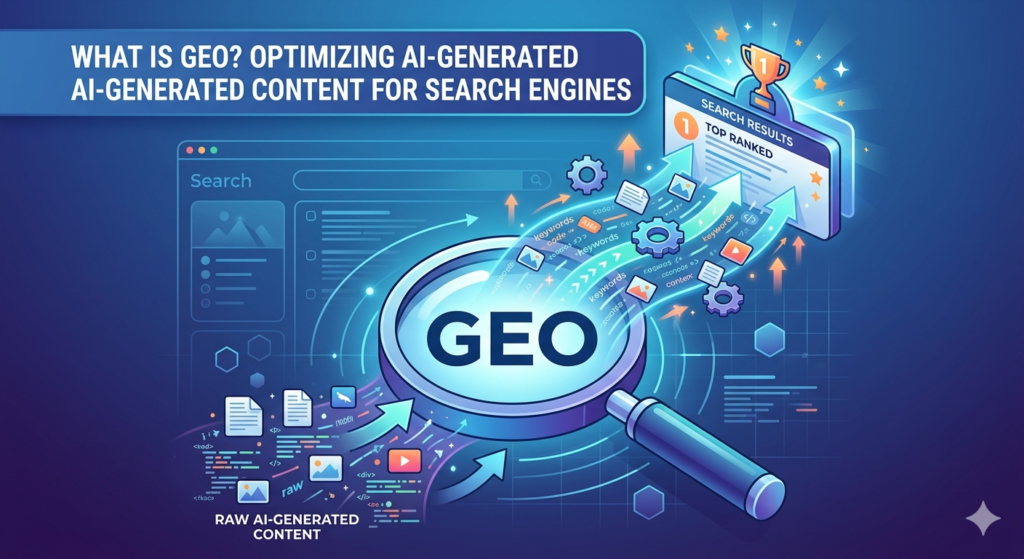
In the age of AI content creation, producing content quickly is no longer enough. To ensure your AI-generated content ranks well on search engines, understanding GEO is critical. GEO stands for “Google E-A-T Optimization”, a methodology designed to enhance content quality, relevance, and authority in search engine results. Let’s dive into what GEO is, why it matters, and how to optimize AI content for SEO effectively.
1. Understanding GEO
GEO is an SEO framework focused on making AI-generated content meet search engine expectations. It primarily emphasizes:
- G – Goal Alignment: Ensuring your content meets the searcher’s intent.
- E – Expertise: Demonstrating authority and trustworthiness in your niche.
- O – Optimization: Structuring content for readability, SEO, and technical requirements.
This approach ensures AI content isn’t just grammatically correct but also valuable, reliable, and discoverable.
2. Why GEO Matters for AI Content
AI tools like GPT-5 can generate content quickly, but raw AI output often lacks:
- Contextual relevance
- Search engine optimization
- Authoritative citations
- User engagement hooks
GEO addresses these gaps. Google and other search engines prioritize content that answers user questions, demonstrates expertise, and is technically optimized. Without GEO, AI content may fail to rank despite being well-written.
3. Goal Alignment: Matching Search Intent
The first step in GEO is ensuring your AI content aligns with search intent:
- Informational: Users want to learn something (e.g., “What is GEO in SEO?”).
- Transactional: Users are ready to buy or subscribe (e.g., “Best AI SEO tools”).
- Navigational: Users want to reach a specific website (e.g., “Outlook Travel AI blog”).
AI tools must be guided to produce content that matches the user’s intent, using the right tone, depth, and keywords.
4. Expertise: Building Authority and Trust
AI-generated content should reflect expertise to be credible:
- Include verified data and statistics.
- Reference authoritative sources.
- Show industry knowledge through examples and insights.
Adding an author bio, credentials, or linking to trusted publications boosts content trustworthiness—a key factor in Google’s E-A-T guidelines.
5. Optimization: Technical SEO for AI Content
Optimization ensures your AI content is discoverable:
- Keyword Research: Identify target keywords and related terms.
- Meta Tags: Craft SEO-friendly titles, descriptions, and headings.
- Internal & External Linking: Enhance relevance and authority.
- Readability: Use short paragraphs, bullet points, and subheadings.
- Multimedia Elements: Images, charts, and videos enhance engagement.
AI can generate content quickly, but manual optimization ensures it reaches the right audience.
6. Best Practices for AI Content under GEO
- Pre-Plan the Structure: Outline headings, subtopics, and key points before generating content.
- Fact-Check AI Output: Verify any AI-generated claims, statistics, or references.
- Enhance Human Touch: Add anecdotes, case studies, or personal insights.
- Optimize for Featured Snippets: Use bullet points, Q&A formats, and concise definitions.
- Regularly Update Content: AI content should evolve to stay relevant and accurate.
7. Common Mistakes to Avoid
- Blindly publishing AI content without verification
- Keyword stuffing or unnatural phrasing
- Ignoring user intent
- Not optimizing for mobile and page speed
- Omitting internal links or calls to action
Even AI-generated content can underperform if these mistakes occur.
8. Measuring GEO Success
Track performance using metrics like:
- Organic search traffic
- Rankings for target keywords
- Click-through rate (CTR) from SERPs
- User engagement (time on page, bounce rate)
- Backlinks and shares
Regular audits help refine AI content strategies to maintain high SEO performance.
9. Future of GEO in AI Content
As AI continues to evolve, GEO principles will become even more critical. Search engines are increasingly capable of detecting low-value content, making optimization, trust signals, and expertise essential. Combining AI efficiency with GEO ensures high-quality, rank-worthy content that engages readers and satisfies search engines.
FAQs:
-
What does GEO stand for in SEO?
GEO stands for Goal alignment, Expertise, and Optimization, a framework for improving AI-generated content for search engines. -
Why is GEO important for AI content?
It ensures AI content is relevant, authoritative, and optimized, improving rankings and user engagement. -
How does Goal Alignment improve SEO?
By matching content with searcher intent informational, transactional, or navigational—it increases relevance and visibility. -
What role does Expertise play in GEO?
Expertise shows authority and trustworthiness, often through credentials, references, or authoritative sources. -
How do I optimize AI content for GEO?
Focus on keyword usage, headings, meta tags, internal links, readability, and multimedia for search engine and user-friendliness. -
Can AI content rank without GEO optimization?
AI content may rank, but without GEO it often lacks authority, intent alignment, and technical SEO, reducing its effectiveness. -
How can I verify AI-generated content?
Always fact-check data, statistics, and references and add human insights to ensure accuracy and credibility. -
Does GEO apply to all types of AI content?
Yes, GEO is effective for blogs, articles, product pages, and informational content to boost search performance. -
How often should AI content be updated under GEO?
Regularly update content to maintain accuracy, relevance, and SEO performance as search trends and algorithms change. -
What metrics measure GEO success?
Track organic traffic, keyword rankings, CTR, user engagement, and backlinks to evaluate optimization effectiveness.
Conclusion:
GEO is the bridge between AI-generated content and SEO success. By focusing on Goal alignment, Expertise, and Optimization, you can transform AI content from generic text into high-ranking, authoritative, and user-friendly pages. Implementing GEO not only improves visibility but also strengthens your brand’s credibility online.