
AI search engines need to determine which sources are credible enough to reference in their answers. That makes expertise, experience, authoritativeness, and trustworthiness increasingly important for websites competing for visibility in AI-generated search.
An effective E-E-A-T audit can reveal whether your website provides enough evidence for users and AI systems to understand who created your content, why that person is qualified, and whether your claims are supported by reliable information.
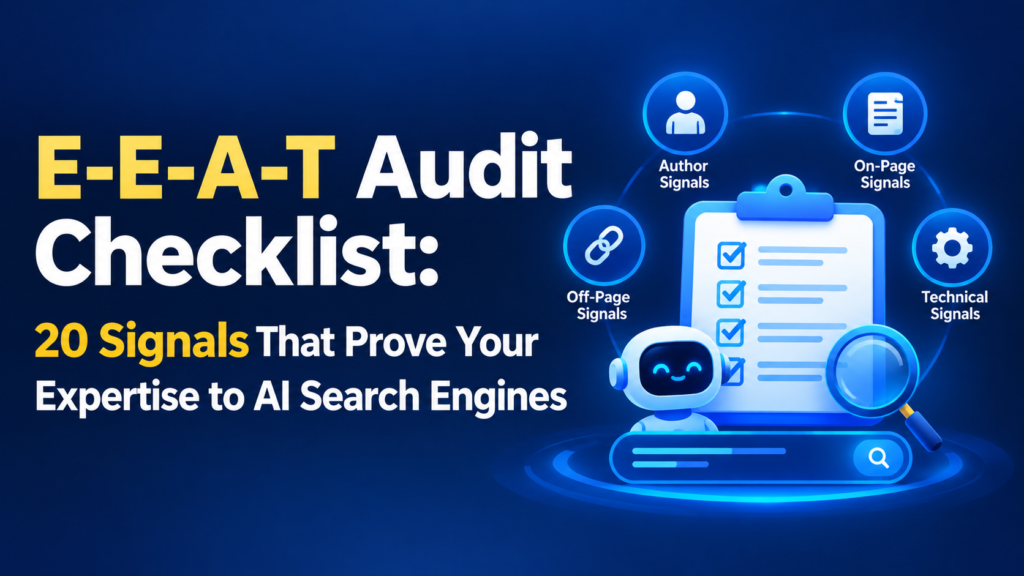
This E-E-A-T checklist gives you 20 practical signals to audit across four areas: author signals, on-page signals, off-page signals, and technical signals.
Each signal can be rated as Yes, Partial, or No, allowing you to identify weaknesses and prioritize improvements.
Important: Google does not publish a single numerical E-E-A-T score. The scoring system in this checklist is an internal auditing framework designed to help you evaluate the strength of your credibility signals.
What Is E-E-A-T in AI Search?
E-E-A-T stands for:
- Experience
- Expertise
- Authoritativeness
- Trustworthiness
These concepts help evaluate whether content demonstrates the qualities users should expect from a reliable source.
For AI search, E-E-A-T is especially relevant because AI systems need to identify useful and credible sources when constructing answers.
A website that clearly establishes its authors, supports claims with evidence, maintains accurate information, and earns recognition from relevant third-party sources gives search and AI systems more context about its credibility.
This does not mean there is one universal E-E-A-T algorithm used by every AI search engine.
Instead, think of E-E-A-T as a framework for building the evidence and context that support generative engine optimization.
Why E-E-A-T Matters for Generative Engine Optimization
Traditional SEO often focuses heavily on rankings, keywords, links, and technical accessibility.
GEO adds another important question:
Why should an AI system trust this source enough to mention or cite it?
A strong GEO strategy therefore needs more than optimized text.
It should also establish:
- Who created the content
- What expertise they have
- Whether they have relevant experience
- Whether claims are supported
- Whether other reputable sources recognize the expert
- Whether the website provides transparent business information
- Whether the content is maintained and updated
- Whether the website is technically accessible to search systems
These are the types of GEO credibility signals worth evaluating during an E-E-A-T audit.
The 20-Point E-E-A-T Audit Checklist
Use the following checklist to evaluate your website.
For every signal, assign:
Yes = 2 points
Partial = 1 point
No = 0 points
With 20 signals worth a maximum of 2 points each, the total possible score is 40 points.
Author Signals
Author signals help establish who is responsible for the information and why that person should be considered knowledgeable about the subject.
1. Does Every Important Article Have a Named Author?
Audit question: Is a real, identifiable author associated with your important content?
Yes: Articles clearly display a named author.
Partial: Only some articles identify their authors.
No: Content is published without meaningful authorship information.
A named author provides an important identity signal. For expert-driven topics, anonymous content can make it harder for users and systems to understand who is responsible for the information.
2. Does the Author Have a Detailed Bio?
Audit question: Does the author page or article bio explain the person’s relevant expertise and experience?
A strong bio should communicate:
- Professional background
- Areas of specialization
- Relevant experience
- Credentials where applicable
- Industry experience
- Publications or achievements
Avoid generic bios that simply say the person is a “marketing expert” without providing evidence.
3. Does the Author Have Relevant First-Hand Experience?
Audit question: Does the content demonstrate that the author has actually worked with, used, studied, tested, or experienced the subject?
Experience is particularly important for topics where first-hand knowledge adds value.
For example, a GEO consultant could strengthen an article by discussing actual AI visibility campaigns, testing methodologies, or real-world observations.
4. Is the Author’s Expertise Consistent Across the Web?
Audit question: Do external profiles and publications reinforce the same expertise shown on your website?
Check:
- Professional profiles
- Guest articles
- Podcast appearances
- Industry publications
- Speaker profiles
- Interviews
- Expert quotes
Consistency helps establish a clearer professional identity.
5. Does the Author Have Third-Party Recognition?
Audit question: Is the author independently recognized by relevant publications, organizations, or industry sources?
Examples include:
- Expert quotes
- Media interviews
- Podcast appearances
- Industry awards
- Conference participation
- Guest bylines
- Expert roundups
These external references can contribute to an author authority audit by providing evidence beyond the author’s own website.
On-Page Signals
Your website should make its expertise and trustworthiness visible within the content itself.
6. Are Author Credentials Clearly Displayed?
Don’t force users to search through your website to discover why an author is qualified.
Important articles should make relevant credentials or expertise easy to find.
An author box can include:
- Name
- Professional title
- Short biography
- Expertise
- Relevant credentials
- Link to the full author profile
Score: ___ / 2
7. Does Your Content Provide Original Insights?
Generic information is easy to reproduce.
Original expertise is harder to replicate.
Look for opportunities to include:
- Original research
- First-hand observations
- Case studies
- Unique frameworks
- Expert commentary
- Original examples
- Proprietary data
Original information gives AI systems and users a stronger reason to recognize your content as useful.
8. Are Important Claims Supported by Evidence?
Review your articles for factual claims, statistics, research findings, and important assertions.
Where appropriate, support claims with:
- Primary sources
- Research
- Official documentation
- Government data
- Academic studies
- Reputable industry sources
Do not add citations merely to make an article appear authoritative. Sources should genuinely support the claims being made.
9. Does the Content Demonstrate Topical Expertise?
A website should demonstrate meaningful depth in the subjects it covers.
Ask:
- Does the author understand the topic beyond basic definitions?
- Are important subtopics covered?
- Does the article answer practical follow-up questions?
- Does the website have related content?
- Are related concepts internally connected?
Topical depth can help establish the context needed for generative engine optimization.
10. Is Content Regularly Reviewed and Updated?
Outdated information can weaken trust.
Audit important pages for:
- Old statistics
- Broken references
- Outdated recommendations
- Expired examples
- Old screenshots
- Changed product information
- Incorrect dates
When content requires updates, make the changes and communicate the review or update date where appropriate.
Off-Page Signals
Off-page signals provide evidence that exists outside your own website.
This is where digital PR can become especially valuable.
11. Does Your Brand Earn Relevant Media Mentions?
Search for your company and experts across reputable publications.
Look for coverage that discusses your actual areas of expertise rather than unrelated brand mentions.
Relevant media coverage can provide useful AI trust signals because it gives AI systems additional third-party information about your organization.
12. Are Your Experts Quoted by Relevant Publications?
Expert commentary can strengthen an individual’s professional identity.
Look for:
- Journalist quotes
- Industry interviews
- Expert commentary
- News articles
- Research commentary
- Expert roundups
The relevance of the publication and topic matters more than simply accumulating mentions.
13. Do Other Authoritative Websites Reference Your Research?
Original research becomes more valuable when other sources reference it.
Examples include:
- Industry statistics
- Original surveys
- Benchmark reports
- Research studies
- Original datasets
- Proprietary analysis
Create research that deserves to be cited rather than producing content solely for link acquisition.
14. Does Your Expert Have Relevant Guest Contributions?
Guest bylines can demonstrate expertise outside your own domain.
Prioritize publications that are:
- Topically relevant
- Credible
- Established
- Read by your target audience
This connects directly with a digital PR for GEO strategy.
Rather than chasing hundreds of low-quality guest posts, focus on a smaller number of meaningful contributions.
15. Is Your Brand’s Online Identity Consistent?
Check whether your company and authors are represented consistently across the web.
Review:
- Company name
- Author names
- Professional titles
- Descriptions
- Website information
- Social profiles
- Industry profiles
Inconsistent information can create ambiguity around the entity you’re trying to establish.
Technical Signals
Technical implementation doesn’t create expertise by itself, but poor technical accessibility can make your credibility signals harder for search engines and AI systems to interpret.
16. Is Author Information Machine-Readable?
Your author information should not exist only as visually styled text.
Where appropriate, use structured data to connect:
- Author
- Person
- Organization
- Article
- Website
Author and entity information should be accurate and consistent.
17. Is Relevant Structured Data Implemented Correctly?
Review your structured data for relevant types such as:
- Article
- Person
- Organization
- BreadcrumbList
- WebSite
Structured data should accurately represent visible page information.
Never use schema markup to claim credentials, awards, or other information that cannot be supported.
18. Can Search Engines Crawl Your Important Content?
A technically inaccessible article cannot perform well regardless of how authoritative it is.
Check:
- Robots directives
- Indexability
- Canonical URLs
- Internal links
- HTTP status codes
- XML sitemaps
- JavaScript-dependent content
- Noindex tags
Make sure important content can be discovered and processed.
19. Does Your Website Provide Clear Trust Information?
Important trust information should be easy to locate.
Depending on the organization, this may include:
- About page
- Contact information
- Editorial policy
- Privacy policy
- Terms
- Author pages
- Company information
- Corrections policy
The exact requirements vary by website and industry, but transparency is generally preferable to hiding important information.
20. Are Your Entity Signals Consistent Across Your Website?
Your website should clearly connect the people, company, products, services, and topics it discusses.
Check whether:
- Authors link to consistent profiles
- Organization information is consistent
- About pages identify the business
- Author pages identify expertise
- Articles identify their creators
- Relevant entities are connected through internal links
- Structured data matches visible information
Strong entity consistency can help provide the context required for generative engine optimization.
E-E-A-T Scoring Guide
Once you’ve completed the checklist, add your scores.
| Score | E-E-A-T Status | What It Means |
|---|---|---|
| 34–40 | Strong | Your website demonstrates comprehensive credibility signals |
| 27–33 | Good | Strong foundation with several opportunities for improvement |
| 20–26 | Moderate | Important E-E-A-T gaps should be addressed |
| 10–19 | Weak | Significant authority and trust signals are missing |
| 0–9 | Critical | Major credibility and entity-identification problems need attention |
Remember that this is an audit scoring system, not an official Google or AI-search ranking score.
A 38/40 score does not guarantee AI citations, just as a lower score does not mean a website can never appear in AI-generated answers.
The value of the score is prioritization.
How to Prioritize Your E-E-A-T Improvements
If your score is low, don’t try to fix all 20 signals simultaneously.
Start with the areas most likely to strengthen the credibility foundation of your website.
Priority 1: Establish Clear Authors
Make sure important content has identifiable authors with meaningful biographies.
Priority 2: Demonstrate Expertise
Add original insights, first-hand experience, relevant credentials, case studies, and evidence.
Priority 3: Build Third-Party Recognition
Use digital PR, expert commentary, podcasts, industry contributions, and relevant media opportunities to establish authority beyond your website.
Priority 4: Strengthen Technical Entity Signals
Review author information, structured data, crawlability, internal linking, and organization information.
Priority 5: Maintain the Evidence
E-E-A-T is not a one-time project.
As your company grows, continue adding:
- New expert contributions
- Updated author profiles
- Original research
- Media coverage
- Expert interviews
- Case studies
- Updated content
- Relevant credentials
How Digital PR Supports E-E-A-T
Your website can claim expertise, but third-party recognition provides additional evidence.
This is why digital PR deserves a place in an E-E-A-T and GEO strategy.
For example, an expert who publishes articles on their own website can strengthen their authority further by:
- Appearing on industry podcasts
- Responding to journalist requests
- Contributing to expert roundups
- Writing guest bylines
- Providing expert commentary
- Publishing original research
Each relevant appearance creates another opportunity to connect the expert with their area of specialization.
E-E-A-T Audit vs. Traditional SEO Audit
A traditional SEO audit might focus heavily on:
- Keywords
- Rankings
- Backlinks
- Page speed
- Technical errors
- Metadata
- Crawlability
An E-E-A-T audit asks different questions:
- Who created this content?
- Why should users trust the author?
- Does the author have relevant experience?
- Are important claims supported?
- Is the expertise recognized externally?
- Is the company transparent?
- Can search systems understand the entities involved?
A strong generative engine optimization strategy should consider both.
Technical SEO makes information accessible.
Content optimization makes information useful.
E-E-A-T makes expertise and credibility easier to establish.
Digital PR creates external evidence.
Together, these elements create a stronger foundation for AI visibility.
How E-E-A-T Can Support AI Citation Strategy
AI citation optimization should not be reduced to inserting keywords or adding more words to an article.
AI systems need to determine which information is useful and which sources are credible enough to include.
Your website can strengthen this foundation by creating a consistent evidence trail:
Expert → Content → Experience → Evidence → Third-Party Recognition → Entity Consistency → AI Visibility
No single signal guarantees an AI citation.
Instead, the objective is to create a comprehensive ecosystem of trustworthy information around your organization and experts.
E-E-A-T Audit Checklist: Quick Version
Use this condensed version when performing a recurring audit.
Author Signals
-
Named author
-
Detailed author bio
-
First-hand experience
-
Consistent expertise across the web
-
Third-party recognition
On-Page Signals
-
Author credentials displayed
-
Original insights
-
Evidence-backed claims
-
Demonstrated topical expertise
-
Content regularly reviewed
Off-Page Signals
-
Relevant media mentions
-
Expert quotations
-
Research references
-
Relevant guest contributions
-
Consistent brand identity
Technical Signals
-
Machine-readable author information
-
Accurate structured data
-
Crawlable important content
-
Clear trust information
-
Consistent entity signals
Frequently Asked Questions
What is an E-E-A-T audit?
An E-E-A-T audit evaluates how effectively a website demonstrates experience, expertise, authoritativeness, and trustworthiness. It examines author information, content quality, third-party recognition, trust information, and technical entity signals.
Does Google have an E-E-A-T score?
No. Google does not provide websites with a public numerical E-E-A-T score. An E-E-A-T score used in an audit is an internal framework for evaluating and prioritizing credibility improvements.
What are GEO credibility signals?
GEO credibility signals are evidence that can help establish the relevance, expertise, authority, and trustworthiness of a website, brand, or expert in the context of AI search. Examples include expert authorship, original research, third-party mentions, relevant citations, and consistent entity information.
How can I improve E-E-A-T?
Start by establishing identifiable authors, improving author biographies, demonstrating first-hand expertise, supporting claims with reliable sources, publishing original information, earning relevant third-party recognition, and maintaining consistent entity information across your website and external profiles.
Does digital PR improve E-E-A-T?
Digital PR can support E-E-A-T by creating relevant third-party evidence of expertise and authority. Expert quotes, media coverage, podcast appearances, guest bylines, and industry contributions can strengthen an expert’s external authority footprint.
What are AI trust signals?
AI trust signals are contextual indicators that can help AI systems understand whether a source is credible and relevant. They can include consistent authorship, authoritative references, original research, expert recognition, reliable sources, and clear organization information.
How do I measure E-E-A-T improvement?
You can measure improvement by auditing changes in author completeness, content evidence, expert mentions, relevant media coverage, third-party references, entity consistency, structured data, and other credibility indicators. Your audit score can be used as an internal benchmark rather than an official search-engine metric.