
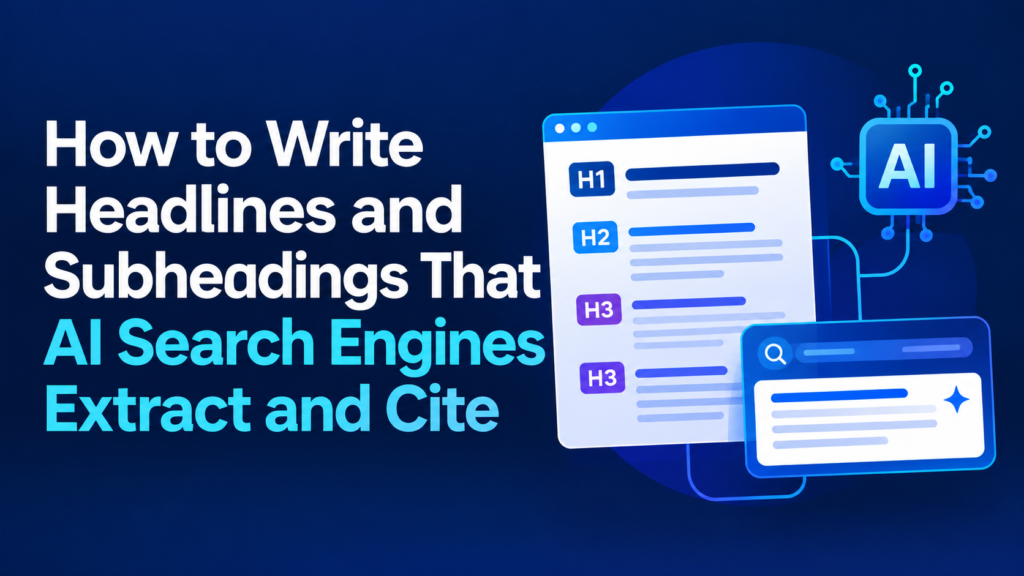
Headlines and subheadings do more than organize a webpage. They help readers understand a topic, help search engines interpret page structure, and give AI-powered search systems useful signals about how information is grouped. For brands investing in Generative Engine Optimization (GEO), a clear heading hierarchy can make content easier to navigate, retrieve, and understand.
Understanding GEO vs SEO is essential when building a content strategy for traditional search engines and AI-powered answer engines. Both approaches benefit from relevant keywords, useful information, and clear structure. GEO also emphasizes making answers easy to identify, verify, and use when AI systems generate responses.
This guide explains how to optimize headings for AI search, structure H2 and H3 sections, incorporate keywords naturally, and improve content clarity with practical before-and-after examples.
GEO vs SEO: How Heading Optimization Differs
Search engine optimization (SEO) focuses on helping webpages rank for relevant queries and satisfy search intent. Generative Engine Optimization focuses on improving the likelihood that useful information will be understood, retrieved, and potentially referenced by AI-powered search and answer systems.
The two approaches overlap considerably. Neither guarantees visibility or citations simply because a page uses a particular heading format.
How traditional SEO uses headings
Headings help establish the hierarchy of a webpage. A descriptive H1 identifies the main topic, H2 headings organize major sections, and H3 headings introduce supporting points.
For SEO, headings can help search engines understand page organization and topic relevance. They also help visitors scan content and locate answers quickly.
How AI search systems interpret headings
AI search systems can use document structure, surrounding text, retrieval methods, and other signals to identify information relevant to a query. Descriptive headings can provide useful context for understanding what a section discusses.
For example, a heading such as “How Does GEO Differ From Traditional SEO?” establishes a clearer subject than “Key Differences.” When the paragraph below directly answers that question, the section becomes easier for both readers and automated systems to interpret.
However, headings alone do not determine whether content will be extracted or cited. Accuracy, relevance, source quality, and the retrieval system also matter.
How to Structure H1, H2, and H3 Headings for AI Search
A consistent heading hierarchy makes long-form content easier to navigate. It also helps establish clear relationships between broad topics and their supporting details.
Use one clear H1 for the main topic
The H1 should describe the primary subject of the page. Keep it specific, readable, and aligned with the search intent.
For this article, the H1 is:
“How to Write Headlines and Subheadings That AI Search Engines Extract and Cite”
Avoid using multiple competing H1 headings for unrelated topics. Although search engines can handle different heading implementations, one clear main heading makes editorial organization easier to maintain.
Use H2 headings for major ideas
Each H2 should introduce a substantial section that addresses one central idea.
For example:
- GEO vs SEO: How Heading Optimization Differs
- How to Structure H1, H2, and H3 Headings for AI Search
- Ten Heading Rewrites That Improve Clarity
- How to Audit Your Website’s Heading Structure
A focused H2 gives readers a clear expectation of what the section will explain. Avoid using vague headings such as “More Tips” or “Other Things to Know” when a more descriptive alternative is possible.
Use H3 headings for specific questions and subtopics
H3 headings should support the main idea introduced by their parent H2. Question-format H3s are especially useful when they match the questions readers actually ask.
For example:
H2: How to Optimize Headings for GEO
H3: Should Your Target Keyword Appear in an H2?
H3: When Should You Use Question-Based Subheadings?
H3: How Long Should an SEO Heading Be?
Not every heading needs to be a question. Use question-based headings when they improve clarity or align with search intent, not simply to make content appear AI-friendly.
Use H4 headings only when additional hierarchy is necessary
H4 headings can organize smaller subtopics within an H3 section. They are useful in detailed technical guides, tutorials, and extensive research articles.
Avoid adding unnecessary heading levels to short sections. If a section contains only a sentence or two, a descriptive paragraph or a short list may be more appropriate.
GEO Heading Optimization: Best Practices That Matter
Effective GEO heading optimization is primarily about helping readers and automated systems understand the purpose of each section without unnecessary ambiguity.
Include keywords naturally in relevant headings
Use your primary keyword and secondary keywords where they accurately describe the section.
For example, a heading such as “GEO vs SEO: Key Differences in Content Optimization” makes sense when the section compares both approaches. Repeating the same keyword in every H2, however, can make the article feel artificial.
Related terms such as “GEO heading optimization,” “H2 and H3 for AI search,” and “subheading structure for LLMs” can be used in appropriate sections.
Keep one main idea per H2
A heading should establish a coherent topic that the section can explain in sufficient detail.
Weak example: “Keywords, AI, Headings, SEO, and Content Marketing”
Better example: “How Heading Structure Helps AI Search Interpret Content”
The improved heading gives the section a clear purpose. Related concepts can be covered underneath it without turning the heading into a list of unrelated keywords.
Make headings specific enough to stand alone
A descriptive heading should communicate the subject even when someone encounters it in a table of contents or a search result.
For example, “How to Validate Article Schema Markup” is more informative than “Validation.”
This is particularly useful for long articles containing several technical topics.
Answer the heading directly in the opening paragraph
After a question-based heading, begin with a concise answer before expanding on the explanation.
For example:
H3: Should You Include Keywords in H2 Headings?
Yes, include a target keyword in an H2 when it naturally describes the section’s subject. Avoid forcing keywords into headings when doing so makes them less clear or less useful.
The remaining paragraphs can explain the reasoning, provide examples, and discuss exceptions.
Avoid clickbait and unsupported promises
Headings such as “The Secret AI Trick That Guarantees Citations” make promises that a content structure cannot reliably deliver.
Prefer accurate descriptions such as “How to Improve Content Clarity for AI Search.”
Credible content should distinguish between established SEO guidance, reasonable optimization practices, and hypotheses that still require testing.
Ten Before-and-After Heading Rewrites for GEO
The following examples demonstrate how to make headings more descriptive, specific, and useful without stuffing them with keywords.
1. Improve a vague GEO heading
Before: GEO Tips
After: How to Optimize Content for Generative Engine Visibility
Why it is better: The revised heading identifies the task and gives readers a clearer idea of what the section covers.
2. Clarify a comparison heading
Before: Differences
After: GEO vs SEO: Key Differences in Search Visibility
Why it is better: It identifies the subjects being compared and incorporates the primary keyword naturally.
3. Turn a broad topic into a question
Before: Heading Optimization
After: How Should You Structure Headings for AI Search?
Why it is better: The question establishes a clear information need that the section can answer directly.
4. Make a keyword heading more readable
Before: H2 H3 for AI Search GEO Heading Optimization
After: How to Use H2 and H3 Headings for AI Search
Why it is better: The revised heading preserves the important concepts while removing awkward keyword repetition.
5. Replace an unclear technical heading
Before: Schema
After: How Schema Markup Helps Search Engines Understand Your Content
Why it is better: It explains the specific relationship the section will discuss. Avoid implying that schema automatically causes AI citations.
6. Make a content-structure heading actionable
Before: Content Structure
After: How to Organize Long-Form Content With Clear H2 and H3 Sections
Why it is better: Readers know both the action and the subject of the section.
7. Clarify an LLM-related heading
Before: LLM Content
After: How Clear Subheadings Help LLMs Interpret Related Information
Why it is better: The revised version describes a specific relationship instead of relying on an ambiguous label.
8. Replace a generic optimization heading
Before: Better Titles
After: How to Write Descriptive Page Titles for Search and AI Discovery
Why it is better: It identifies the element being optimized and the intended context.
9. Make a measurement heading more specific
Before: Results
After: How to Measure AI Search Mentions and Content Citations
Why it is better: It names the metrics the reader should investigate instead of leaving the subject unclear.
10. Turn a generic action heading into a useful next step
Before: Website Audit
After: How to Audit Your Website’s Headings for SEO and GEO
Why it is better: The revised heading identifies the task, the element being reviewed, and the relevant optimization disciplines.
How LLMs Use Headings to Navigate Content
Large language models do not all process webpages in the same way. Depending on the system, content may be crawled, converted into text, divided into passages, indexed, retrieved, or processed alongside other sources.
Well-structured headings can help preserve the context of individual sections throughout these processes.
Headings provide context for individual passages
Imagine a website contains a section explaining how GEO differs from traditional SEO.
If the section begins with a descriptive heading and follows with a focused explanation, the relationship between the topic and the supporting text is relatively clear.
A vague heading such as “Overview” provides less information about the passage’s subject.
Headings can improve content navigation
Clear heading hierarchies help readers and systems identify where one topic ends and another begins. They also support accessible navigation for people using screen readers.
For longer articles, meaningful H2 and H3 headings make it easier to locate relevant sections without reading every paragraph.
Clear sections can support retrieval, but citations are not guaranteed
Some AI search systems retrieve relevant passages from indexed content before generating an answer. In these workflows, section structure and descriptive language may help preserve context and make relevant passages easier to identify.
However, retrieval and citation decisions depend on the platform’s implementation, the query, the available sources, and other relevance signals. There is no universally accepted ideal heading length or formula that guarantees citation.
Title Tag AI Optimization: Page Titles vs. On-Page Headings
The HTML title tag and the visible H1 serve related but distinct purposes.
The title tag helps describe the webpage in browser tabs and may be used as the title shown in search results. The H1 communicates the main topic to visitors reading the page.
Write a concise, descriptive title tag
For this article, a suitable title tag is:
“GEO vs SEO: How to Optimize Headings for AI Search”
It incorporates the primary keyword while accurately describing the article’s focus.
Keep the H1 aligned with the page’s actual content
The H1 can be more explanatory than the title tag, provided both describe the same central subject.
Avoid using a title tag about GEO vs SEO if the article only discusses generic copywriting without making the comparison meaningful.
Avoid treating title tags and headings as citation triggers
A descriptive title helps communicate relevance, but there is no guarantee that a page will be selected by an AI answer engine. Focus on accurate titles, useful information, sound technical implementation, and a good user experience.
How Heading Optimization Connects With Schema Markup
Headings and schema markup play different roles in website organization.
Headings structure visible content for readers and provide contextual clues about the relationships between topics. Structured data describes supported information about a page or entity in a machine-readable format.
Use schema markup that matches visible content
For an appropriate article, Article or BlogPosting structured data can identify properties such as the headline, author, publication date, and featured image.
Breadcrumb structured data can describe a page’s place within the website hierarchy.
The markup should accurately reflect the page and follow the search engine’s relevant guidelines. It should not contain invented author details, unsupported claims, or information that conflicts with the visible page.
Connect heading structure with your schema content strategy
A sensible implementation process is to:
- Organize the article with meaningful H1, H2, and H3 headings.
- Keep the page title, visible headline, and structured-data headline consistent in meaning.
- Use appropriate Article and Breadcrumb markup where supported.
- Validate the markup and fix implementation errors.
- Review internal links connecting related GEO and technical SEO articles.
For further guidance, read our related articles on schema markup and structured data for SEO and AI search.
Common Heading Optimization Mistakes to Avoid
Keyword stuffing
Repeating “GEO vs SEO” in every heading makes content harder to read. Use the phrase where the comparison is genuinely relevant and use natural variations elsewhere.
Skipping heading levels without a reason
Use headings to establish a logical hierarchy rather than choosing a level simply because its visual styling looks attractive. Use CSS for appearance and heading levels for document structure.
Using generic headings for important sections
Headings such as “Introduction,” “More Information,” and “Conclusion” can be acceptable in some contexts, but descriptive alternatives are often more helpful for substantial sections.
Writing headings that promise more than the section delivers
A heading should accurately describe the material underneath it. Do not promise a guaranteed increase in citations when the section only discusses general content recommendations.
Ignoring the reader’s actual question
A heading can include every target keyword and still fail if it does not address the user’s information need. Prioritize relevance and clarity over keyword placement alone.
How to Audit Your Website’s Heading Structure
A GEO heading audit should examine whether the article is organized around clear, useful topics rather than simply counting keyword occurrences.
Review the heading hierarchy
Check whether the page has a clear main heading and whether H2 and H3 headings follow a logical structure. Look for unnecessary heading levels, duplicated headings, and sections that combine unrelated ideas.
Evaluate heading relevance
Ask whether each heading accurately describes the section beneath it. Confirm that important headings address the search intent and that relevant keywords appear naturally.
Review the content beneath each heading
Check whether the opening paragraph answers the heading’s question, whether the supporting information is accurate, and whether the section contains sufficient explanation to be useful.
Check technical implementation
Use browser inspection tools or an SEO crawler to review the rendered heading elements. Also check title tags, canonical URLs, indexability, internal links, and appropriate structured data.
Measure performance over time
Use Google Search Console to review impressions, clicks, and query performance. Where available, monitor AI referral traffic and track citations across a consistent set of relevant queries.
Changes to headings should be evaluated alongside other page improvements. Search visibility and AI citations can fluctuate, and a change in headings alone does not establish causation.
Get Your Content Audited for GEO and SEO
Clear headings are one part of a broader content optimization strategy. To improve your website’s chances of being understood and discovered, you also need relevant information, strong topical coverage, accurate sourcing, appropriate internal links, and sound technical SEO.
If your articles are difficult to navigate, repeat the same ideas, or fail to answer key questions directly, a structured content audit can help identify the most important improvements.
Want to improve your content for search engines and AI-powered discovery? Get your content audited. Review your heading hierarchy, keyword targeting, content structure, internal linking, and schema implementation to uncover opportunities for improvement.
A useful audit should provide specific findings, prioritized recommendations, and actionable changes—not promises of guaranteed rankings or AI citations.
Frequently Asked Questions
How does GEO differ from SEO in heading optimization?
SEO heading optimization focuses on organizing content, communicating relevance, and helping users and search engines understand a page. GEO heading optimization applies these same principles to content intended to be discovered, retrieved, and potentially cited by AI-powered search systems. Both benefit from clear, descriptive headings, useful answers, and relevant keywords.
How do H2 and H3 headings help AI search engines understand content?
H2 headings organize the main topics of an article, while H3 headings introduce supporting ideas or specific questions. This hierarchy provides context about how information is related, making content easier for readers and automated systems to navigate. However, headings alone do not guarantee AI citations.
Should I include my primary keyword in H2 and H3 headings?
Include your primary keyword in a heading when it naturally describes the section’s content. Use related terms and variations in other headings where relevant. Avoid repeating the same keyword unnaturally, as clarity and relevance are more important than keyword frequency.
Are question-based subheadings better for GEO?
Question-based subheadings can be useful when they reflect the questions your audience actually asks. They allow you to introduce a specific question and provide a direct answer beneath it. However, descriptive statements can be equally effective when they communicate the topic more clearly.
How many H2 and H3 headings should an article have?
There is no fixed number of H2 or H3 headings that guarantees SEO rankings or AI citations. Use enough headings to organize the article into meaningful sections. The appropriate number depends on the article’s length, complexity, and search intent.
What is the ideal heading length for AI search optimization?
There is no universally established ideal heading length for AI search. Aim for concise, descriptive headings that communicate the section’s purpose without unnecessary words. A heading should be long enough to provide context but short enough to scan easily.
What is the difference between an H1, H2, and H3 heading?
An H1 identifies the main topic of a webpage. H2 headings divide the content into major sections, and H3 headings organize supporting topics within those sections. A logical hierarchy improves readability, accessibility, and content navigation.
Do headings directly influence whether AI search engines cite a webpage?
Headings can help communicate context and organize information, but they are not a direct guarantee of citation. AI search systems may consider relevance, content quality, source credibility, retrieval signals, and other factors when selecting information for generated answers.
What is the difference between a title tag and an H1 heading?
A title tag is an HTML element that describes a webpage and may appear in search results and browser tabs. An H1 is the primary visible heading within the page content. They can use different wording as long as both accurately represent the page’s main topic.
Does schema markup improve GEO heading optimization?
Schema markup and heading optimization serve different purposes. Headings organize visible content, while schema provides structured information about a page or its entities. Accurate, appropriate structured data can help search engines interpret supported page information, but it does not guarantee AI visibility or citations.
How can I audit my headings for GEO and SEO?
Review your H1, H2, and H3 hierarchy, check whether each heading accurately describes its section, and ensure keywords appear naturally. Evaluate whether sections answer their intended questions, then inspect internal links, title tags, indexability, and relevant structured data. Use Search Console and consistent AI-search tests to monitor performance over time.
Can poorly written headings reduce content visibility in AI search?
Vague, misleading, or poorly organized headings can make content harder for readers and automated systems to interpret. Improving heading clarity may support better navigation and context, but visibility also depends on the usefulness, relevance, accessibility, and overall quality of the content.