
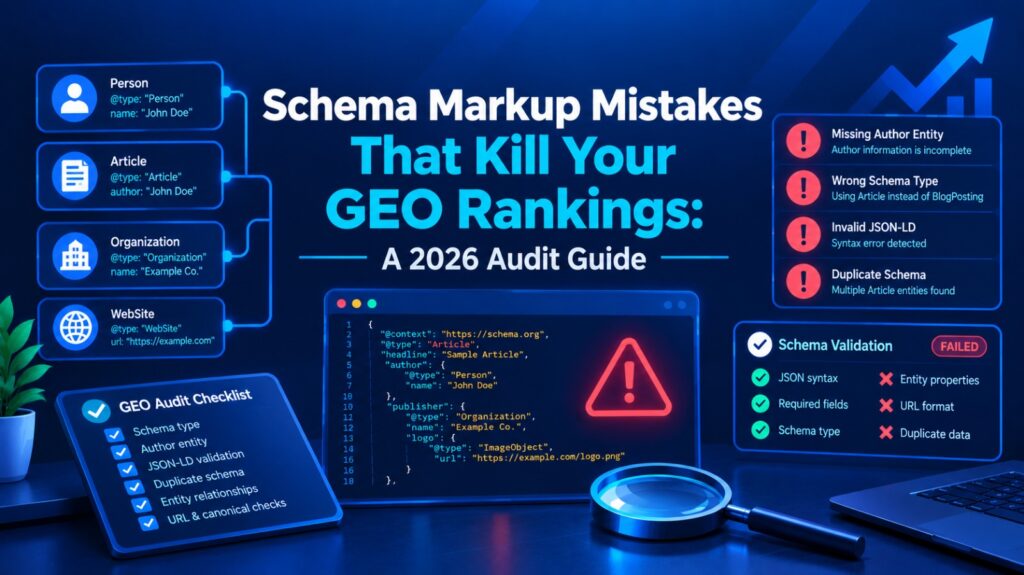
Schema markup is supposed to help search engines and machines understand what your content represents. But poorly implemented structured data can create the opposite problem: ambiguous entities, conflicting information, invalid JSON-LD, duplicate markup, and inaccurate descriptions of your pages.
For businesses investing in generative engine optimization, schema deserves more attention than simply adding a few JSON-LD snippets and assuming the technical work is finished.
AI search systems use multiple signals to discover, retrieve, interpret, and cite information. There is no schema markup formula that guarantees AI citations or higher rankings. However, accurate and well-maintained structured data can contribute to a clearer machine-readable representation of your content and entities.
That makes schema auditing an important part of a broader GEO technical audit.
In this guide, we’ll cover 10 common schema markup mistakes, explain how to identify them, and provide a practical 2026 audit checklist you can use to review your website.
What Is Schema Markup?
Schema markup is structured data added to a webpage to describe information in a machine-readable format.
Most modern implementations use JSON-LD, which is embedded in the page’s HTML and can describe entities such as:
- Articles
- Organizations
- People
- Products
- Events
- FAQs
- Breadcrumbs
- Local businesses
- Web pages
- Websites
For example, an article can be connected to its author, publisher, publication date, and main webpage.
A simplified relationship might look like:
Article → Person → Organization
This gives machines additional context about how different entities relate to one another.
However, structured data should accurately represent the visible content and purpose of the page. Adding schema simply because a particular type appears popular in SEO discussions can create more problems than it solves.
Why Schema Matters for Generative Engine Optimization
Traditional search optimization often focuses heavily on rankings and search-result features. Generative engine optimization expands the goal to include visibility across AI-powered search and answer experiences.
When AI systems retrieve information from the web, they need to identify relevant content, understand its subject matter, determine relationships between entities, and evaluate information alongside other available sources.
Schema is one part of the technical ecosystem that can help communicate those relationships.
But it’s important to keep expectations realistic.
Schema does not guarantee that ChatGPT, Gemini, Perplexity, Google AI features, or another AI system will cite your website.
AI visibility also depends on factors such as:
- Content relevance
- Search intent
- Information quality
- Crawlability
- Source accessibility
- Entity clarity
- Content freshness
- Evidence and supporting sources
- Query context
- The retrieval system used by the AI platform
That is why schema should be treated as part of a broader GEO strategy rather than a standalone citation tactic.
10 Schema Markup Mistakes That Can Hurt Your GEO Strategy
1. Missing or Incomplete Author Entity
One of the most common structured data problems is failing to clearly identify who created the content.
An article might display:
Written by Sarah Williams
while the underlying structured data provides little or no useful information about that person.
For websites publishing expertise-driven content, this can result in weaker connections between the article and its author entity.
A well-structured implementation can identify the author as a Person and connect that person to the article.
Depending on the website, useful author information may include:
- Name
- Author URL
- Profile page
- Relevant
sameAsreferences - Professional information
- Relationship to the article
For example:
Article → author → Person
The goal isn’t to add as much markup as possible. The goal is to make the relationship accurate and consistent.
GEO audit question
Can a machine clearly determine who wrote this content and where that author entity is represented on the website?
If the answer is no, your author implementation deserves attention.
2. Using the Wrong Schema Type
Another common mistake is selecting a schema type because it sounds useful rather than because it accurately describes the page.
For example, a business might use:
HowToon an opinion articleProducton a service pageFAQPagewhen the page doesn’t actually contain a qualifying FAQ structureEventon a general announcementArticlewhen a more specific applicable type is appropriate
Schema should describe what the page actually contains.
Before implementing structured data, ask:
What is this page?
Is it:
- An article?
- A product?
- An organization?
- A local business?
- A service?
- An event?
- A webpage containing a specific content format?
Choosing the correct schema type is more important than trying to use every available schema type.
Structured data rule
Don’t make your page fit the schema. Choose schema that accurately represents your page.
3. Publishing Untested JSON-LD
JSON-LD can look correct to a human while containing technical errors that prevent proper interpretation.
Common JSON-LD validation problems include:
- Missing quotation marks
- Invalid commas
- Incorrect brackets
- Misspelled properties
- Invalid property values
- Incorrect nesting
- Invalid URLs
- Incorrect data types
- Broken entity relationships
For example, manually editing JSON-LD directly inside a CMS can introduce a small syntax error that affects the entire markup block.
This is why validation should be part of your publishing workflow.
Before publishing
Check:
- Is the JSON valid?
- Are schema properties correctly named?
- Are URLs correct?
- Does the markup represent the visible content?
- Are entity relationships valid?
- Are required or recommended properties appropriately populated?
Don’t assume that because the page loads normally, the structured data is correct.
4. Creating Duplicate Schema
Duplicate structured data is especially common on WordPress and other CMS-based websites.
A website may have schema generated by:
- An SEO plugin
- A schema plugin
- The website theme
- A page builder
- Custom developer code
- Google Tag Manager
- Manually inserted JSON-LD
You may therefore end up with multiple versions of the same entity on one page.
For example:
Article schema from Plugin A
plus
Article schema from Plugin B
plus
Article schema manually inserted by a developer
The page may still appear normal to visitors, but the underlying markup can become unnecessarily complicated or contradictory.
How to audit duplicate schema
Inspect the page source and identify every JSON-LD block.
Then ask:
- How many Article entities exist?
- How many Organization entities exist?
- Are multiple plugins generating the same schema?
- Do duplicate entities have different information?
- Are multiple
@idvalues being used for the same entity?
Your objective should be a clear, intentional schema architecture, not simply more structured data.
5. Making Schema Different From Visible Content
One of the most important rules of structured data is accuracy.
Problems occur when the information in your markup doesn’t match what users can actually see.
For example:
Visible page:
Published: September 15, 2026
Schema:
datePublished: 2025-04-12
Or:
Visible author:
John Smith
Schema author:
Jane Williams
Or:
Visible content:
A general article
Schema:
A product with pricing and review information that isn’t actually presented on the page.
These inconsistencies create unnecessary ambiguity.
A GEO technical audit should therefore compare structured data against the actual rendered page rather than validating JSON-LD in isolation.
Audit rule
If the structured data says it exists, verify that the page genuinely supports that information.
6. Failing to Connect Related Entities
Another common mistake is treating every schema object as an isolated piece of data.
For example, a page may contain:
- An Article
- A Person
- An Organization
- A WebSite
But those entities aren’t properly connected.
Instead of simply adding multiple objects, consider the relationships between them.
A content page might logically connect:
WebSite → WebPage → Article → Person
while the author may be connected to an organization through their profile or professional relationship.
Entity relationships can provide additional context about what each piece of information represents.
Useful properties can include:
@idauthorpublishermainEntityOfPageisPartOfaboutsameAs
The exact implementation depends on the page and entity structure.
GEO audit question
Can you follow the relationships between the page, content, author, publisher, and website?
If every entity appears disconnected, review the implementation.
7. Using Outdated or Unsupported Schema Assumptions
Schema and search features evolve.
One of the biggest SEO mistakes is assuming that because a structured data type exists, it automatically creates a search feature or improves visibility.
Those are different things.
There is a difference between:
Schema.org vocabulary
and
eligibility for a particular search-engine feature.
A markup type can remain part of a structured-data vocabulary without guaranteeing a rich result, special search treatment, or AI citation.
This matters particularly in GEO because the AI search ecosystem is changing rapidly.
Don’t implement structured data based solely on an old SEO tutorial.
Instead, periodically review:
- Current Schema.org definitions
- Current search-engine documentation
- Deprecated properties
- Your actual implementation
- Changes to your CMS or plugins
- Changes to your website templates
A 2026 schema audit should be based on the current state of your website and the current documentation—not assumptions from several years ago.
8. Incorrect URLs, @IDs, and Canonical References
Entity identification becomes harder when your structured data contains inconsistent URLs.
Common issues include:
- HTTP URLs in schema while the website uses HTTPS
- Non-canonical URLs
- Trailing-slash inconsistencies
- Incorrect author URLs
- Broken profile URLs
- Incorrect
@idreferences - Multiple identifiers for the same entity
For example, your website may identify an article using one URL while the canonical tag points to another.
During a GEO technical audit, review the relationship between:
- Canonical URL
url@idmainEntityOfPage- Author URL
- Publisher URL
Consistency is more useful than creating complicated identifiers that aren’t maintained.
9. Conflicting Schema From Plugins, Themes, and Custom Code
Sometimes the problem isn’t that schema is missing.
The problem is that too many systems are generating it.
This is particularly common when a website has changed SEO plugins or developers over time.
Imagine this setup:
Theme → Organization schema
SEO plugin → Organization schema
Schema plugin → Organization schema
Custom developer code → Organization schema
Now imagine that each implementation contains slightly different information.
One says:
Organization name: Example Company
Another says:
Organization name: Example Co.
Another uses a different logo URL.
Another uses a different @id.
This can create an unnecessarily fragmented entity structure.
What to check
During your audit, identify:
- Which system generates each schema block
- Whether multiple systems describe the same entity
- Whether the data is consistent
- Whether old implementations remain active
- Whether custom JSON-LD duplicates plugin output
A clean implementation is easier to maintain than a collection of overlapping schema systems.
10. Treating Schema as a One-Time SEO Task
Adding schema once and never checking it again is another common mistake.
Websites change constantly.
You may:
- Change your CMS
- Install a new plugin
- Change your theme
- Redesign templates
- Change authors
- Update URLs
- Move content
- Change your organization details
- Add new content types
- Remove old pages
Any of these changes can affect structured data.
That’s why schema should become part of your ongoing technical SEO and generative engine optimization process.
For larger websites, consider scheduled audits that check:
- JSON-LD validity
- Duplicate markup
- Entity consistency
- Author information
- Canonical URLs
- Schema/page consistency
- Broken references
- Template-level changes
Schema isn’t a “set it and forget it” task.
2026 GEO Schema Audit Checklist
Use this checklist when reviewing your website’s structured data.
Schema Architecture
-
Correct schema type selected
-
Schema accurately represents the page
-
Schema matches visible content
-
No unnecessary schema types added
Author & Entity Data
-
Author entity is clearly identified
-
Author URL is correct
-
Publisher entity is identified where appropriate
-
Organization information is consistent
-
Relevant entities are connected
-
@idvalues are intentional and consistent
JSON-LD Validation
-
JSON-LD syntax is valid
-
Property names are correct
-
Values use appropriate formats
-
URLs are valid
-
Required/relevant properties are populated
-
No broken nesting exists
Duplicate & Conflicting Schema
-
No duplicate Article schema
-
No duplicate Organization schema
-
No duplicate Person schema
-
Plugins aren’t generating overlapping markup
-
Theme-generated schema has been reviewed
-
Custom JSON-LD has been reviewed
URL & Technical Checks
-
Schema URLs use the correct protocol
-
Canonical URL matches the intended page
-
urlis accurate -
mainEntityOfPageis accurate where used -
Author and publisher URLs resolve correctly
-
No outdated references remain
Ongoing Monitoring
-
Schema is reviewed after major website changes
-
CMS/plugin updates are checked
-
New templates are audited
-
Important pages are periodically revalidated
-
GEO visibility is monitored alongside technical changes
Downloadable Schema Audit Checklist
Want to turn this audit into a repeatable process?
Create a downloadable version of this checklist for your team:
Download the 2026 GEO Schema Audit Checklist
The downloadable checklist can include columns for:
| Audit Item | Status | URL | Issue Found | Recommended Fix |
|---|---|---|---|---|
| Author entity | ☐ | |||
| Schema type | ☐ | |||
| JSON-LD validation | ☐ | |||
| Duplicate schema | ☐ | |||
| Entity relationships | ☐ | |||
| Canonical URLs | ☐ | |||
| Visible-content match | ☐ | |||
| Plugin conflicts | ☐ |
This format makes it easier for SEO teams, developers, and agencies to document technical issues and prioritize fixes.
How Much Does a Schema Audit Cost?
Schema audit pricing depends on the website’s size, CMS, number of templates, amount of structured data, and whether the audit includes remediation.
A simple pricing framework could look like this:
| Schema Audit Package | Best For | Typical Scope |
|---|---|---|
| Basic Schema Audit | Small websites | JSON-LD validation, common errors, duplicate-schema review |
| GEO Schema Audit | Businesses focused on AI search | Schema architecture, entity relationships, JSON-LD, GEO-specific technical review |
| Enterprise Schema Audit | Large websites | Multiple templates, complex entity architecture, large-scale validation, prioritized recommendations |
For service providers, pricing should be based on the actual scope rather than simply the number of pages.
A 20-page website with complicated custom schema can require more technical investigation than a 100-page site using a standardized template.
What should a professional schema audit include?
Depending on the package, a professional audit can include:
- Schema inventory
- JSON-LD validation
- Duplicate-schema detection
- Entity analysis
- Author and publisher review
- Canonical consistency checks
- CMS/plugin conflict analysis
- Technical recommendations
- Priority levels
- Implementation guidance
- Post-fix validation
For websites investing seriously in generative engine optimization, a GEO-focused schema audit can also be integrated into a broader technical visibility assessment.
Schema Errors vs. GEO Problems: What’s the Difference?
It’s important not to treat every AI visibility problem as a schema problem.
For example, a website might have perfectly valid JSON-LD but still receive limited visibility in AI search.
Why?
Because schema is only one part of the larger system.
A broader GEO assessment may need to investigate:
Technical accessibility
→ Can relevant pages be crawled and retrieved?
Content quality
→ Does the page provide useful, specific information?
Evidence
→ Are important claims supported?
Entity clarity
→ Is the business, author, product, or organization clearly represented?
Content structure
→ Can important answers and facts be easily identified?
Freshness
→ Is information maintained when the subject changes?
AI visibility
→ Does the brand or page appear in relevant AI-generated answers?
This is why schema auditing works best as part of a complete GEO framework.
How to Measure the Impact of Technical GEO Improvements
Fixing schema is only the beginning.
After implementing changes, establish a measurement process to determine whether your broader GEO strategy is producing meaningful visibility changes.
Track metrics such as:
- AI search visibility
- Citation frequency
- Brand mentions
- Source inclusion
- Query-level visibility
- Referral traffic where measurable
- Organic search performance
- Changes following technical implementations
For a deeper approach, connect this audit with your Measuring GEO Performance content cluster and develop a repeatable process for tracking AI search visibility over time.
The key is to avoid claiming that a schema fix automatically caused an increase in AI citations. Test changes systematically and document what actually changes.
Final Thoughts: Schema Is Infrastructure, Not a Magic GEO Shortcut
Schema markup can provide useful machine-readable context, but it shouldn’t be treated as a shortcut to AI rankings or citations.
The most common problems are surprisingly basic:
- Missing author entities
- Incorrect schema types
- Untested JSON-LD
- Duplicate markup
- Schema that doesn’t match visible content
- Poor entity relationships
- Outdated implementations
- Incorrect URLs and identifiers
- Conflicting plugin-generated schema
- No ongoing monitoring
Fixing these issues gives your website a cleaner technical foundation for search and AI visibility.
But the strongest generative engine optimization strategy combines technical accessibility with useful content, clear entities, credible information, strong site architecture, and ongoing measurement.
Need a Professional GEO Technical Audit?
Not sure whether your schema implementation is helping or creating unnecessary technical problems?
Book a GEO technical audit to identify schema markup errors, JSON-LD issues, duplicate structured data, entity inconsistencies, and other technical opportunities across your website.
A professional audit can give your team a prioritized roadmap of what to fix, what to monitor, and where technical GEO improvements fit into your wider AI search strategy.
Frequently Asked Questions
Does schema markup improve generative engine optimization?
Schema markup can provide machine-readable information about a page and its entities, but there is no established guarantee that adding schema will improve AI citations or rankings. Its value should be evaluated as part of a broader technical and content-focused GEO strategy.
What are the most common schema markup errors?
Common errors include choosing the wrong schema type, invalid JSON-LD, duplicate schema, incomplete author entities, incorrect URLs, conflicting plugin-generated markup, and structured data that doesn’t accurately match the visible page.
How do I validate JSON-LD?
Start by checking the JSON-LD syntax and then use appropriate structured-data testing and validation tools. Also manually compare the markup against the rendered page to make sure the structured data accurately represents the content.
Can duplicate schema hurt SEO or GEO?
Duplicate or conflicting schema can make an implementation unnecessarily complicated and may create ambiguity. The goal should be a clean, accurate, consistent structured-data implementation rather than simply adding more schema.
Should every page have schema markup?
No. Structured data should be used when it accurately describes the content or entities represented on a page. Adding irrelevant schema simply to increase the amount of structured data is not a sound strategy.
Does schema guarantee AI citations?
No. Schema does not guarantee citations from ChatGPT, Gemini, Perplexity, Google AI features, or other AI search systems. AI visibility depends on multiple retrieval, content, technical, and contextual factors.
How often should I audit schema markup?
Important websites should review schema whenever major CMS, plugin, template, URL, or content changes occur. A periodic technical audit can also identify errors introduced gradually as the website evolves.