
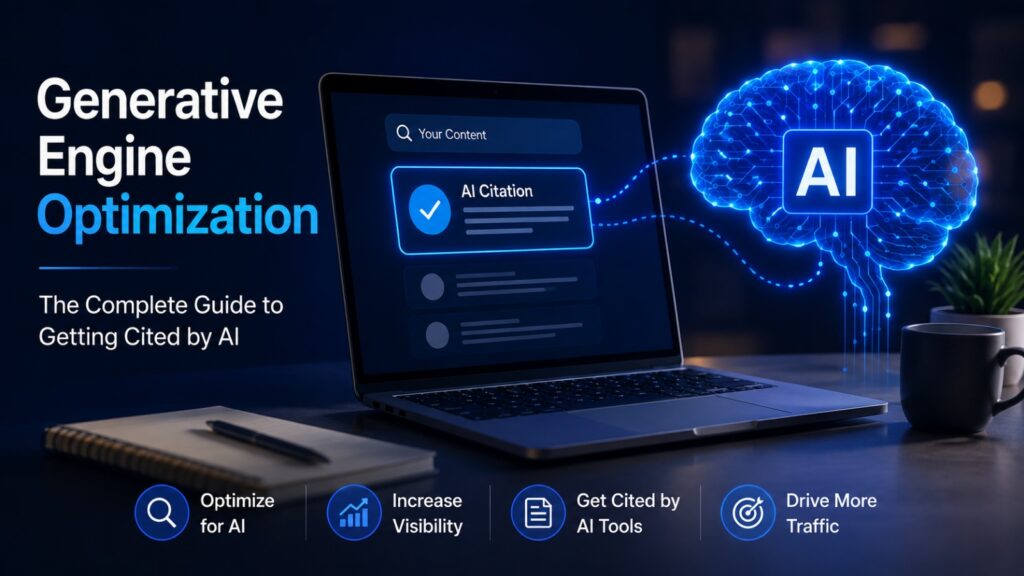
Generative Engine Optimization (GEO) is the practice of optimizing content so that AI-powered search and answer engines can understand, trust, reference, and cite it when generating responses.
Traditional SEO focuses heavily on rankings and clicks from search engine results pages. GEO adds another objective: making your brand and content a source that large language models and AI search systems can confidently use in their answers.
If your goal is to improve AI search visibility, getting cited by ChatGPT, Google AI features, Gemini, Perplexity, and other answer engines requires more than adding keywords to a page. It requires a combination of topical authority, clear information, credible sources, strong brand signals, structured content, and consistent digital presence.
This complete GEO guide explains how the process works and provides a practical workflow you can use to improve your chances of being discovered and cited by AI systems.
What Is Generative Engine Optimization?
Generative Engine Optimization is the process of creating and optimizing digital content so that generative AI systems can accurately discover, interpret, evaluate, and potentially reference that content when answering user questions.
GEO overlaps with SEO, but the objectives are different.
With traditional SEO, the primary question is:
How can I rank higher for a search query?
With GEO, the question becomes:
How can I become a trusted source that an AI system can use when answering that question?
GEO therefore involves much more than keyword placement. It includes:
- Building topical authority
- Demonstrating expertise and credibility
- Creating factually clear content
- Supporting claims with reliable sources
- Strengthening brand and entity signals
- Structuring information so machines can interpret it easily
- Building relevant mentions across the web
- Keeping important information current
- Measuring AI visibility and citations
Think of GEO as an extension of search optimization for an environment where the final result may be an AI-generated answer rather than a list of blue links.
Why AI Citations Matter
AI-generated answers increasingly summarize information from multiple sources.
When an AI search system provides citations, the cited websites receive something extremely valuable: source-level visibility at the moment a user is seeking an answer.
A citation can help a brand:
- Demonstrate authority
- Increase brand awareness
- Generate qualified referral traffic
- Reinforce expertise
- Build trust with prospective customers
- Become associated with a specific topic or entity
There is also an important distinction between being mentioned and being cited.
An AI system may know that a company exists without linking to its website. A citation is stronger because the system has selected a specific source to support or expand its response.
That’s why a modern LLM citation strategy should focus on becoming a source worth referencing, not merely trying to get a brand name into AI-generated text.
How Do LLMs Select Sources?
There is no single publicly documented formula that determines why an AI system chooses one source instead of another.
Different systems use different models, retrieval systems, indexes, ranking processes, training data, and search integrations.
However, several characteristics consistently make content easier for AI systems to understand and evaluate.
1. Relevance
The source needs to directly address the question.
A highly authoritative website can still be a poor source for a particular answer if its page doesn’t clearly address the topic.
2. Topical authority
A site that consistently publishes useful information about a subject can establish stronger topical relevance than a site with one isolated article.
For example, a website publishing comprehensive research about GEO is more likely to establish a recognizable association with GEO than a general marketing site containing a single GEO article.
3. Information clarity
AI systems need to interpret the information on a page.
Clear headings, concise explanations, descriptive language, logical organization, tables, definitions, and explicit answers can all make information easier to process.
4. Credibility
Sources, author information, original research, expert contributions, and reputable references can strengthen the credibility of a page.
5. Consensus and corroboration
When multiple reputable sources independently support a fact or concept, it can become easier for AI systems to recognize that information as reliable.
This makes external mentions and digital PR particularly relevant to GEO.
6. Freshness
Some topics change quickly.
Statistics, software features, industry trends, product information, and AI developments should be reviewed and updated when necessary.
A page that was accurate two years ago may not be the strongest source today.
Stage 1: Build a Strong GEO Foundation
Before optimizing individual articles, establish the foundation of your website.
Your site should make it immediately clear:
- Who you are
- What your organization does
- What topics you specialize in
- Who your experts are
- What information you publish
- How users can contact you
Create clear About, Contact, author, and editorial pages.
For organizations, maintain consistent company information across important profiles and directories.
For authors, provide meaningful biographies that establish relevant experience.
These signals help create a clearer connection between people, organizations, topics, and expertise.
Stage 2: Build Topical Authority
One article rarely establishes authority by itself.
Instead, create a content cluster around important subjects.
For example, a GEO cluster might include:
- What Is Generative Engine Optimization?
- GEO vs SEO
- How AI Search Works
- How to Structure Content for AI Search
- How to Get Cited by ChatGPT
- Brand Signals for GEO
- Digital PR for GEO
- How to Measure GEO
- GEO for B2B
- GEO for E-commerce
- GEO Case Studies
- Content Refresh for GEO
Your hub article should link to these supporting resources, while the supporting resources should link back to the hub.
This creates a connected knowledge structure rather than a collection of isolated blog posts.
Stage 3: Identify Questions AI Users Actually Ask
Traditional keyword research remains useful, but GEO requires a broader approach.
Don’t focus only on:
“generative engine optimization”
Also identify the questions people ask AI systems about the subject.
For example:
- What is GEO?
- How does GEO work?
- How do I get cited by ChatGPT?
- Does SEO affect AI search?
- How do LLMs choose sources?
- How can a brand appear in AI search?
- How do I measure AI visibility?
- What makes content citation-worthy?
These conversational questions can become article sections, FAQs, supporting pages, and entire content clusters.
Stage 4: Create Citation-Worthy Content
The objective isn’t simply to produce longer content.
The objective is to produce better sources.
A citation-worthy page should make useful information easy to identify and verify.
Use:
- Clear definitions
- Original research
- Statistics with sources
- Expert commentary
- Examples
- Comparisons
- Tables
- Step-by-step processes
- First-hand observations
- Updated information
- Transparent methodology
Whenever you make a factual claim, consider whether the reader—or an AI system—can determine where that information came from.
Create information that is easy to quote and attribute
Instead of burying your main answer inside five paragraphs, state the answer clearly.
For example:
Generative Engine Optimization is the practice of optimizing content and brand signals to improve visibility and potential citation within AI-powered search and answer systems.
Then explain the concept in detail.
Clear statements reduce ambiguity and make the page more useful as a reference.
Stage 5: Optimize Content Structure for AI Search
Structure matters.
Use a logical hierarchy:
H1 → H2 → H3
Each H2 should address a meaningful stage or question.
Use short paragraphs and descriptive subheadings.
Where appropriate, include:
- Bullet lists
- Numbered procedures
- Comparison tables
- Definitions
- Examples
- FAQs
For complex subjects, tables can make relationships between concepts immediately understandable.
Avoid forcing keywords into every heading.
Instead, make headings describe the information that follows them.
Stage 6: Strengthen Your LLM Citation Strategy
A successful LLM citation strategy extends beyond your own website.
Think about your brand’s entire information footprint.
Relevant signals can come from:
- Industry publications
- News websites
- Professional organizations
- Research publications
- Interviews
- Podcasts
- Expert roundups
- Partner websites
- Conference appearances
- Reputable directories
- Social profiles
The objective isn’t to manufacture mentions.
It is to build legitimate recognition around your expertise.
For example, if your company specializes in GEO, relevant third-party coverage discussing your research or expertise can reinforce that association.
This is one reason digital PR can play an important role in GEO.
Stage 7: Strengthen Brand and Entity Signals
AI systems need to distinguish entities from one another.
Make your organization’s identity consistent.
Use the same:
- Brand name
- Organization description
- Founder/expert names
- Website information
- Social profiles
- Business details
where appropriate.
Connect your organization with the subjects it genuinely specializes in.
For example:
ExplainGeo → Generative Engine Optimization → AI Search → GEO Research
The more consistently that relationship is represented across authoritative sources, the clearer the entity association can become.
Stage 8: Make Expertise Visible
Don’t hide expertise.
Create detailed author pages.
Include:
- Author name
- Relevant experience
- Areas of specialization
- Professional background
- Credentials where applicable
- Links to professional profiles
- Published research
- Editorial review information
For sensitive or technical topics, consider expert review.
A strong content page should answer not only:
What does this page say?
but also:
Why should I trust the person or organization saying it?
Stage 9: Add Original Research and Data
Original research is one of the strongest ways to differentiate a GEO-focused publication.
Instead of repeatedly explaining what other websites already say, conduct experiments.
For example:
GEO Experiment: Do Statistics Increase AI Citations?
ChatGPT vs Gemini vs Google AI: Which Sources Are Cited Most Often?
100 GEO Queries: What Characteristics Do Cited Pages Share?
GEO Visibility Study: Which Content Formats Appear Most Frequently in AI Answers?
Document:
- Research question
- Methodology
- Sample
- Results
- Limitations
- Conclusions
Then publish the findings.
Other websites can reference original research, creating additional authority and citation opportunities.
Stage 10: Keep Important Content Fresh
GEO is developing rapidly.
Review important pages regularly.
Check:
- Statistics
- Product features
- Search behavior
- AI platform capabilities
- Examples
- Screenshots
- Links
- Industry terminology
Don’t update a page simply to change its publication date.
Update it when the information has actually changed or when you can meaningfully improve it.
Stage 11: Build Supporting External Signals
Content authority doesn’t exist only on your domain.
Earn relevant mentions through legitimate methods such as:
- Digital PR
- Original research
- Expert interviews
- Industry commentary
- Partnerships
- Conferences
- Podcasts
- Data studies
- Useful tools
- Thought leadership
The goal is to make your expertise visible throughout the broader web.
Avoid low-quality link schemes, mass guest posting, or artificial mentions.
Quality and relevance matter more than raw volume.
Stage 12: Measure GEO Performance
GEO requires different measurements from traditional SEO.
You shouldn’t abandon SEO metrics. Instead, add AI-search metrics to the measurement framework.
SEO vs GEO Metrics
| Measurement | Traditional SEO | GEO / AI Search |
|---|---|---|
| Primary visibility | Search rankings | AI answer visibility |
| Main result | Search result | AI-generated response |
| Core metric | Rankings | Mentions/citations |
| Traffic | Organic clicks | AI referral traffic |
| Authority | Backlinks/domain signals | Citations, mentions, entity signals |
| Query type | Keywords | Questions/prompts |
| Optimization target | Search engine | AI/answer engine |
| Content goal | Rank and earn clicks | Be understood and referenced |
| Measurement | GSC, analytics, rank tracking | AI query monitoring + analytics + citation tracking |
| Brand impact | SERP visibility | Inclusion in AI-generated answers |
The two disciplines overlap.
In fact, strong technical SEO and strong content remain important foundations for GEO.
But GEO adds another layer: becoming a trusted source within an answer ecosystem.
Stage 13: Test Whether You Can Get Cited by ChatGPT
Don’t assume your GEO strategy is working.
Test it.
Build a representative set of questions related to your target topics.
For each question, record:
- Was the brand mentioned?
- Was the website cited?
- Which competitor was cited?
- Which page was cited?
- What type of source was selected?
- Was the answer accurate?
- Did the result change between tests?
Repeat testing over time.
The objective isn’t to force an AI system to cite your site.
It’s to understand how your visibility changes and identify opportunities for improvement.
Stage 14: Create a GEO Optimization Checklist
Before publishing an important page, run through the following checklist.
GEO Content Checklist
-
Does the page directly answer a clear question?
-
Is the primary topic obvious?
-
Does the page demonstrate relevant expertise?
-
Are important factual claims supported?
-
Are the author and organization clearly identified?
-
Is the information current?
-
Are headings descriptive and logically organized?
-
Are important answers stated clearly?
-
Are examples included where useful?
-
Could original data or research strengthen the page?
-
Does the page link to relevant supporting resources?
-
Do supporting articles link back to this page?
-
Are important external sources cited?
-
Is the content easy to scan?
-
Are unnecessary filler sections removed?
-
Does the page provide something genuinely useful that competing pages don’t?
A Practical GEO Workflow
Putting everything together, a practical workflow looks like this:
1. Choose the topic
Identify an important subject within your expertise.
2. Research user questions
Find the questions people ask about that subject.
3. Analyze competing sources
Study the pages and organizations already being referenced.
4. Build the content plan
Create the hub and supporting pages needed to cover the topic comprehensively.
5. Create authoritative content
Answer questions directly and provide useful evidence, examples, and original insights.
6. Structure the information
Use descriptive headings, concise explanations, lists, tables, and logical navigation.
7. Add expertise signals
Show who created, reviewed, and stands behind the information.
8. Strengthen internal links
Connect related pages into a coherent topical cluster.
9. Build external authority
Earn relevant mentions, citations, interviews, and coverage.
10. Test AI visibility
Run representative queries and record mentions and citations.
11. Improve weak areas
Identify topics where competitors consistently outperform you.
12. Update and repeat
GEO isn’t a one-time optimization project. Treat it as an ongoing process.
GEO Is More Than “Optimizing for ChatGPT”
It’s tempting to define GEO as:
“How to get cited by ChatGPT.”
That’s too narrow.
AI search is evolving quickly, and different systems can retrieve and synthesize information differently.
The durable strategy is therefore not to optimize for one model.
Instead, build a website that is:
- Technically accessible
- Topically authoritative
- Factually reliable
- Clearly structured
- Expert-backed
- Well referenced
- Consistently represented across the web
- Useful to humans
Those principles can remain valuable even as individual AI platforms change.
Common GEO Mistakes
Mistake 1: Publishing large quantities of generic AI content
More content does not automatically create authority.
Mistake 2: Obsessing over one keyword
AI users ask questions, not just keywords.
Mistake 3: Ignoring external authority
Your own website isn’t the only place where your expertise needs to exist.
Mistake 4: Hiding authorship
Anonymous content provides fewer visible expertise signals.
Mistake 5: Making unsupported claims
A page full of assertions isn’t automatically authoritative.
Mistake 6: Creating isolated articles
A strong content cluster is more useful than disconnected pages.
Mistake 7: Measuring only rankings
You can rank well and still have limited AI visibility.
Mistake 8: Optimizing only for machines
The best GEO strategy still starts with creating genuinely useful content for people.
The Future of Generative Engine Optimization
Search is moving toward systems that don’t simply return documents—they interpret questions, synthesize information, and provide answers.
That changes the role of content.
A successful website won’t only compete to appear at the top of a results page. It will compete to become a trusted information source that search and AI systems can confidently use.
That is the fundamental opportunity behind generative engine optimization.
The brands that invest early in expertise, original research, topical authority, strong entity signals, and useful information will be better positioned as AI-mediated discovery becomes more important.
Final GEO Checklist
If you want a simple framework to remember, use this:
Understand → Build → Structure → Prove → Connect → Measure → Improve
Understand what your audience asks.
Build comprehensive topical authority.
Structure information so people and machines can understand it.
Prove expertise with evidence, authorship, sources, and original research.
Connect your website to the wider information ecosystem.
Measure AI visibility, mentions, citations, and referral traffic.
Improve continuously based on what you learn.
GEO isn’t about finding a secret trick that forces ChatGPT or another AI system to cite your website.
It’s about building the kind of information source that deserves to be cited.
Want to Put This Into Practice?
Use the GEO Checklist to turn the framework in this guide into a repeatable optimization process. Work through each stage, identify gaps on your website, and prioritize the improvements most likely to strengthen your AI search visibility.
Continue Exploring ExplainGeo
Build your GEO knowledge with these supporting resources:
- GEO vs SEO: Understand the key differences between traditional search optimization and generative engine optimization.
- How to Structure Content for AI Search: Learn how content organization can improve machine readability and answer extraction.
- How to Get Cited by ChatGPT: Explore practical strategies for becoming a stronger source for AI-generated answers.
- Brand Signals for GEO: Understand why consistent brand and entity information matters.
- Digital PR for GEO: Learn how third-party authority and relevant mentions can support AI visibility.
- How to Measure GEO: Build a framework for tracking AI-search performance.
- GEO Case Studies: Examine real-world examples and practical GEO strategies.
- Content Refresh for GEO: Learn how updating existing content can strengthen its usefulness and relevance.
- GEO for B2B: Explore strategies for improving AI visibility in B2B markets.
- GEO for E-commerce: Learn how product and commercial content can be optimized for AI-driven discovery.
Pingback: AI Search Optimization: Ideal Paragraph Length for GEO
Pingback: llms.txt Explained: Does Your Site Need One for AI Search?
Pingback: AI Search Visibility Tracking: Measure GEO Results