
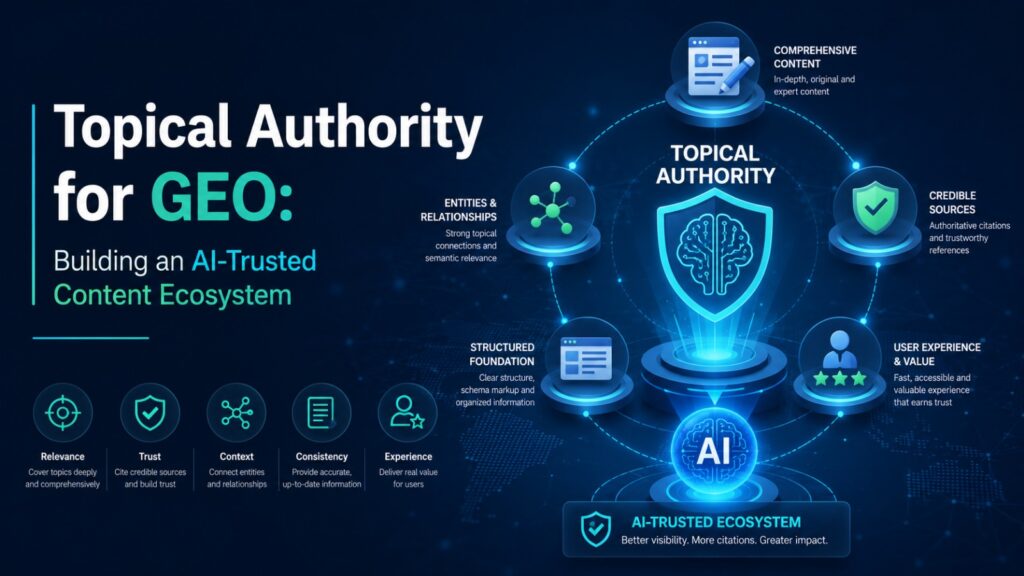
As AI-powered search continues to evolve, publishing a few optimized articles is no longer enough to earn visibility. AI search engines prioritize brands that demonstrate consistent expertise across an entire subject rather than isolated pieces of content. This is where topical authority GEO becomes a critical strategy.
Topical authority goes beyond traditional SEO by helping AI systems understand the depth, relevance, and credibility of your knowledge. Instead of evaluating individual pages in isolation, AI models assess how well your content ecosystem covers a topic and whether your website can be trusted as a reliable source of information.
In this guide, you’ll learn what topical authority means in Generative Engine Optimization (GEO), why AI search values comprehensive content, and how to build an interconnected content strategy that increases your chances of being cited by AI platforms like ChatGPT, Gemini, Claude, and Perplexity.
What Is Topical Authority?
Topical authority is the level of expertise and trust your website establishes around a specific subject. It is built by publishing comprehensive, high-quality content that thoroughly covers all aspects of a topic rather than focusing on individual keywords.
For example, instead of writing one article about GEO, a website with strong topical authority would publish multiple in-depth resources covering:
- GEO fundamentals
- AI search ranking factors
- Schema markup for AI search
- Brand signals
- AI citations
- Content optimization
- Knowledge graphs
- Entity SEO
- AI search analytics
Together, these articles demonstrate expertise and help AI search engines recognize your website as an authoritative source within the GEO niche.
Why AI Search Values Content Depth
AI search engines are designed to answer complex user questions with accurate and trustworthy information. To do this, they evaluate not only the quality of an individual article but also the overall depth of content published by a website.
Comprehensive topic coverage signals that your brand has genuine expertise. When multiple related articles support one another, AI systems can better understand your specialization and are more likely to reference your content in generated responses.
Content depth also improves semantic understanding. AI models connect related concepts, identify recurring themes, and recognize how different pieces of content contribute to a broader knowledge base. The more complete your coverage, the stronger your authority becomes.
Instead of creating disconnected blog posts, focus on building an organized library of content that answers every major question your audience may ask about a topic.
Creating Content Clusters
One of the most effective ways to build topical authority GEO is by organizing your website into content clusters.
A content cluster consists of one comprehensive pillar page supported by multiple related articles that explore individual subtopics in greater detail. This structure helps both users and AI systems navigate your content more effectively.
Pillar Content
Pillar content serves as the central resource for a broad topic. It provides a complete overview while linking to more detailed supporting articles.
For example, if your primary topic is Generative Engine Optimization, your pillar page could introduce concepts such as:
- Brand signals
- AI search optimization
- Structured data
- Topical authority
- AI citations
- Content clusters
- Knowledge graphs
Rather than covering each topic exhaustively, the pillar page acts as the foundation that connects readers to specialized content.
An effective pillar page should:
- Cover the topic comprehensively
- Target broad, high-value keywords
- Include clear navigation
- Link naturally to supporting resources
- Be updated regularly as the topic evolves
Supporting Articles
Supporting articles focus on individual subtopics in much greater detail.
For example, articles like:
- Brand Signals in GEO
- AI Search Ranking Factors
- Schema Markup for GEO
- Entity SEO Explained
- Measuring AI Visibility
Each article strengthens your expertise while supporting the broader pillar page.
This interconnected structure allows AI search engines to understand relationships between concepts, making your website more authoritative and increasing the likelihood of AI-generated citations.
Internal Linking for GEO
Internal linking is a fundamental component of topical authority because it connects related content into a cohesive knowledge ecosystem.
When articles link naturally to one another, AI systems gain additional context about how topics relate. These connections reinforce your expertise and make it easier for search engines to crawl, interpret, and organize your content.
Effective internal linking should:
- Connect related articles naturally within the content
- Link supporting pages back to the pillar page
- Use descriptive anchor text
- Help users discover relevant information
- Keep navigation logical and intuitive
A strong internal linking strategy also improves user experience by guiding readers through your content in a meaningful way, increasing engagement and reducing bounce rates.
Instead of treating each article as a standalone resource, build a connected network that demonstrates your expertise across an entire subject area.
Measuring Authority Growth
Building topical authority is an ongoing process, so it’s important to monitor your progress over time.
Some of the most valuable metrics include:
- Growth in organic traffic
- AI-generated citations
- Keyword visibility across related topics
- Internal link coverage
- Indexed pages
- Brand mentions
- Backlinks from authoritative websites
- User engagement metrics such as time on page and return visits
You should also regularly evaluate whether your content answers emerging questions within your niche. As AI search evolves, updating existing articles and expanding your content clusters will help maintain your authority.
Remember that topical authority is built gradually. Consistent publishing, continuous optimization, and comprehensive topic coverage produce stronger long-term results than isolated content campaigns.
Conclusion
As AI-powered search becomes more sophisticated, establishing topical authority GEO is essential for long-term visibility. AI search engines increasingly favor websites that demonstrate deep expertise through comprehensive, interconnected content rather than isolated keyword-focused pages.
By creating pillar pages, publishing high-quality supporting articles, strengthening internal links, and continuously expanding your content ecosystem, you can build lasting authority that earns trust from both users and AI systems. The result is greater visibility, more AI citations, and a stronger competitive position in the future of search.
Frequently Asked Questions
What is topical authority in GEO?
Topical authority in GEO refers to the level of expertise a website demonstrates across a specific subject through comprehensive, interconnected content. Strong topical authority helps AI search engines recognize your website as a trusted source of information.
How does topical authority affect AI citations?
AI search engines are more likely to cite websites that consistently publish in-depth, high-quality content covering an entire topic. Strong topical authority increases trust, improves semantic understanding, and enhances your chances of being referenced in AI-generated answers.
How many articles are needed to build topical authority?
There is no fixed number. Topical authority depends on the quality, depth, and completeness of your content rather than article count. Many successful content clusters begin with one pillar page supported by 10–20 well-researched articles and continue to expand over time.
What is the difference between topical authority and domain authority?
Domain authority measures the overall strength of a website based largely on backlinks and external signals, while topical authority focuses on demonstrating expertise within a specific subject through comprehensive and interconnected content.
How long does it take to establish topical authority?
Building topical authority typically takes several months of consistent publishing and optimization. The timeline depends on your industry’s competitiveness, content quality, internal linking strategy, and how effectively your website demonstrates expertise across related topics.