
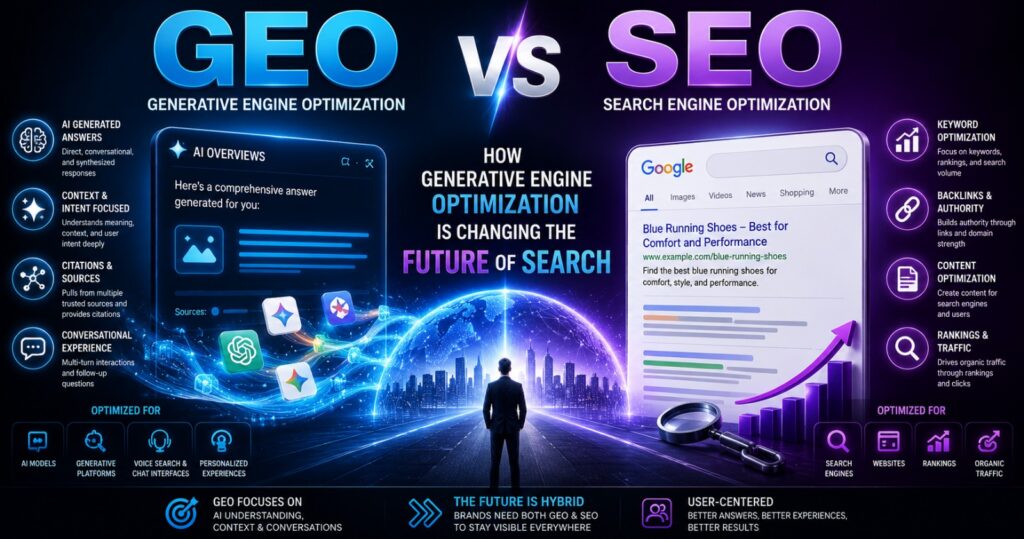
The digital landscape is undergoing a seismic shift. For over two decades, Search Engine Optimization (SEO) has been the cornerstone of digital visibility but a new discipline is rapidly emerging alongside it: Generative Engine Optimization (GEO). As AI-powered tools like ChatGPT, Google’s AI Overviews, Perplexity, and Microsoft Copilot increasingly become the first point of contact for user queries, understanding how GEO and SEO work together is no longer optional it’s essential for anyone serious about digital presence.
What Is SEO (Search Engine Optimization)?
Search Engine Optimization is the practice of optimizing your website and content so that it ranks higher in search engine results pages (SERPs) like Google, Bing, and Yahoo. Traditional SEO focuses on a combination of on-page factors, off-page signals, and technical elements to improve organic visibility.
The core pillars of SEO include:
- Keyword Research: Identifying the terms and phrases your target audience types into search engines.
- On-Page Optimization: Crafting content with proper heading structure (H1, H2, H3), keyword placement, internal linking, and meta tags.
- Technical SEO: Ensuring your website loads fast, is mobile-friendly, has clean crawlable code, and uses structured data (Schema markup).
- Link Building: Earning backlinks from authoritative websites to boost your domain authority.
- User Experience (UX): Improving Core Web Vitals, bounce rate, and dwell time to signal quality to search algorithms.
SEO has evolved significantly from keyword stuffing in the early 2000s to today’s focus on E-E-A-T (Experience, Expertise, Authoritativeness, and Trustworthiness). Despite this evolution, the fundamental goal remains the same: help search engines understand your content so they can match it with relevant user queries.
What Is GEO (Generative Engine Optimization)?
Generative Engine Optimization is the emerging practice of optimizing content specifically to be surfaced, cited, or featured by AI-powered generative engines. Unlike traditional search engines that return a list of links, generative engines synthesize information from across the web and deliver direct, conversational answers.
When someone asks ChatGPT “What is the best strategy for local SEO in 2026?” or queries Perplexity “How does GEO differ from SEO?”, these AI systems pull from a vast training corpus and live web data. GEO is about making your content the source that gets cited, paraphrased, or recommended in those AI-generated responses.
Key strategies for GEO include:
- Authority and Expertise Signals: AI models heavily favor content from recognized experts and authoritative domains. Building topical authority in your niche is critical.
- Structured, Factual Content: Generative AI prefers content that is clear, factual, and well-organized with definitive answers, statistics, and step-by-step guidance.
- Comprehensive Coverage: Long-form, in-depth content that covers a topic exhaustively is more likely to be drawn upon by AI models.
- Citing and Being Cited: Content that references credible sources and earns citations from other reputable sites signals trustworthiness to AI systems.
- Conversational Tone and Q&A Format: AI systems excel at answering questions structuring your content around specific questions and direct answers improves GEO performance.
GEO vs SEO: Key Differences
While GEO and SEO share overlapping goals getting your content in front of the right audience they differ in several fundamental ways.
| Aspect | SEO | GEO |
|---|---|---|
| Target Platform | Google, Bing, Yahoo SERPs | ChatGPT, Perplexity, Google AI Overviews, Copilot |
| Output Format | Ranked list of URLs | Direct AI-generated answers with citations |
| Primary Signal | Backlinks, keywords, technical health | Authority, factual accuracy, comprehensiveness |
| User Behavior | Click-through to website | Consume answer directly; may or may not visit source |
| Measurability | Rankings, organic traffic, CTR | AI citations, brand mentions, indirect referral traffic |
| Content Style | Keyword-optimized, structured for crawlers | Conversational, authoritative, factual, Q&A-driven |
Why Both GEO and SEO Matter in 2026
A critical mistake many digital marketers make today is treating GEO and SEO as competing strategies. In reality, they are deeply complementary. A well-executed SEO strategy builds the domain authority, structured content, and technical foundation that also makes your site a prime candidate for AI citations.
Consider this: Google’s AI Overviews which now appear at the top of search results for a growing percentage of queries pull content directly from highly-ranked, authoritative web pages. If your SEO is strong, you’re already halfway toward appearing in AI-generated summaries. Conversely, a GEO-focused approach that emphasizes depth, expertise, and factual clarity will naturally produce content that ranks well in traditional SERPs too.
According to research from BrightEdge, AI-driven search features now influence over 60% of all search interactions. Brands that optimize for both traditional SEO and generative AI visibility are seeing significantly higher total search impression share compared to those focused on SEO alone. Explore real-world GEO case studies to see how leading brands are winning at AI search.
How to Build a Combined GEO + SEO Strategy
Here is a practical framework for integrating GEO and SEO into a unified content strategy:
1. Establish Deep Topical Authority
Build topic clusters around your core subject matter. For a site like ExplainGEO, this means creating comprehensive, interlinked content that covers every dimension of GEO from beginner definitions to advanced optimization tactics. Both Google and AI engines reward deep, consistent expertise in a specific domain.
2. Write for Humans, Structure for Machines
Your content should flow naturally for human readers while being structured in a way that both search engine crawlers and AI models can easily parse. See our guide on how to structure content for AI search for a full breakdown. Use clear H2 and H3 headings, bullet points for lists, numbered steps for processes, and schema markup where applicable.
3. Optimize for Featured Snippets and AI Answers
Featured snippets and AI Overviews often pull from content that directly answers a question in the first 1-2 sentences of a section. Frame your headings as questions (e.g., “What is Generative Engine Optimization?”) and immediately follow with a concise, accurate answer before expanding on the topic.
4. Build E-E-A-T Signals
Google’s E-E-A-T framework (Experience, Expertise, Authoritativeness, Trustworthiness) is increasingly influencing both traditional rankings and AI citation decisions. Publish author bios with credentials, cite data sources, earn mentions in industry publications, and ensure your About page clearly establishes your brand’s expertise.
5. Target Conversational and Long-Tail Keywords
AI tools are query-driven users ask full questions, not just short keyword phrases. Optimize for long-tail, conversational queries like “How does GEO affect my website traffic?” or “What’s the difference between GEO and SEO for small businesses?” alongside traditional short keywords.
6. Earn High-Quality Backlinks and Citations
Backlinks remain a powerful SEO signal, and they also contribute to the type of cross-web authority that generative AI models use to identify trustworthy sources. Guest posting, digital PR, and earning links from authoritative industry publications remain vital tactics.
7. Monitor AI Visibility Alongside Traditional Metrics
Use tools like Semrush’s AI Overview tracker, Ahrefs, or dedicated GEO monitoring tools to track how often your brand and content are being cited or referenced in AI-generated responses. Combine this with traditional SEO metrics like organic traffic, keyword rankings, and backlink profile growth.
The Future of Search: A GEO-First World?
The rise of generative AI in search is not a replacement for traditional SEO at least not yet. Google, Bing, and other traditional search engines still drive massive volumes of web traffic, and SEO best practices remain highly effective. However, the trajectory is clear: AI-mediated search is growing rapidly, and the brands that invest in GEO today will have a significant advantage as these platforms mature.
Think of GEO as the next evolution of SEO. Just as SEO evolved from basic keyword insertion to a sophisticated discipline covering technical health, content quality, and user experience, GEO represents the next layer optimizing for the AI-powered search experiences that will define the next decade of the internet.
Conclusion
GEO and SEO are not rivals they are partners in a comprehensive digital visibility strategy. By investing in deep topical authority, high-quality factual content, strong E-E-A-T signals, and a technical SEO foundation, you position your content to thrive in both traditional search results and AI-generated answer engines.
The question is no longer “Should I focus on SEO or GEO?” it’s “How quickly can I build a strategy that excels at both?” Start with the fundamentals outlined in this guide, track your performance across both traditional and AI-driven search channels, and adapt as the landscape continues to evolve.
Stay ahead of the curve because in the age of generative AI, visibility is everything.
Pingback: GEO vs SEO: How to Optimize Headings for AI Search