
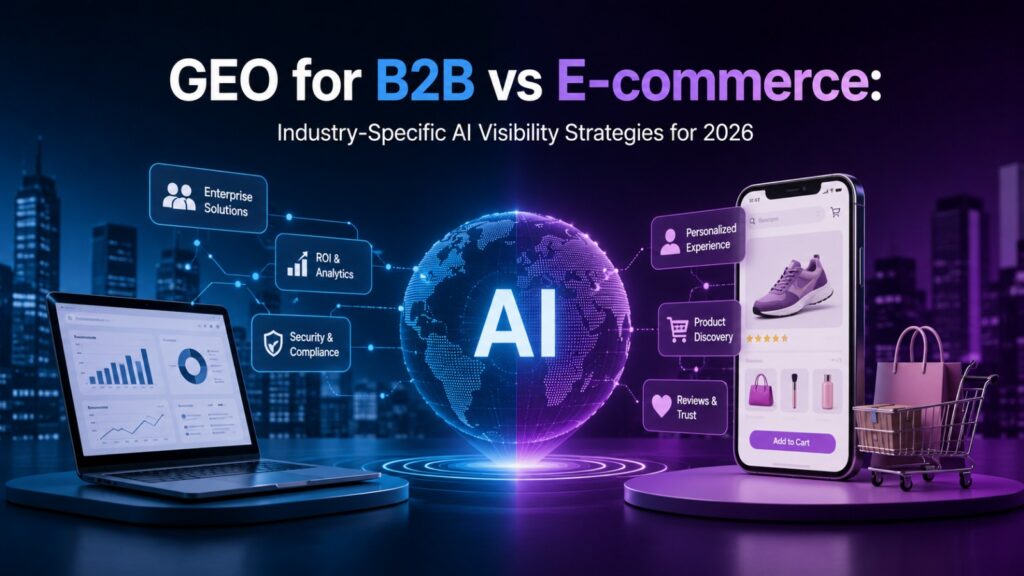
Generative Engine Optimization (GEO) is rapidly becoming a critical component of digital marketing. As AI-powered platforms like ChatGPT, Google AI Overviews, Perplexity, Gemini, and Claude increasingly influence how people discover products, services, and information, brands must rethink their visibility strategies.
However, not all GEO strategies are created equal.
A B2B SaaS company and an e-commerce retailer may both want visibility in AI-generated responses, but the methods they use to achieve that visibility can be dramatically different.
B2B companies typically succeed through thought leadership, expertise, entity building, and educational content. E-commerce brands, on the other hand, often rely on product data, customer reviews, structured information, and transactional content that AI systems can easily reference.
Understanding these differences is essential for developing an effective industry GEO strategy.
In this guide, we’ll compare GEO for B2B and e-commerce businesses, examining the content types, schema implementations, authority signals, and success metrics that drive AI visibility in each sector.
Understanding GEO Across Different Industries
At its core, GEO focuses on increasing a brand’s likelihood of being cited, referenced, or recommended by AI systems.
Unlike traditional search engines that primarily rank pages, generative engines synthesize information from multiple sources to create answers.
To appear in those answers, brands must establish themselves as trustworthy entities and reliable information sources.
The challenge is that AI systems evaluate B2B and e-commerce brands differently because users have different intentions.
For example:
- A B2B buyer may ask ChatGPT for software recommendations or implementation advice.
- An e-commerce shopper may ask for the best products in a category or compare alternatives.
These distinct user behaviors require different optimization strategies.
GEO for B2B Companies
Why GEO Matters for B2B
B2B purchasing decisions are often complex, involving multiple stakeholders, extensive research, and long sales cycles.
As AI search tools become research assistants for buyers, B2B companies have an opportunity to influence decision-making earlier in the customer journey.
When a potential customer asks:
“What are the best CRM platforms for enterprise sales teams?”
the brands cited by AI systems gain significant visibility and credibility.
Core GEO Strategy #1: Build Strong Brand Entities
Entity recognition is one of the most important aspects of B2B generative engine optimization.
AI systems need clear signals about:
- What your company does
- Which industry you serve
- What products or services you provide
- How experts and publications reference your brand
Successful B2B companies focus heavily on:
- Company profile consistency
- Knowledge graph visibility
- Industry citations
- Branded mentions
- Executive thought leadership
The stronger your entity footprint, the more likely AI systems are to reference your business.
Core GEO Strategy #2: Publish Thought Leadership Content
B2B buyers seek expertise.
As a result, AI systems frequently prioritize:
- Industry research
- Whitepapers
- Original studies
- Expert commentary
- Trend analysis
Thought leadership content helps establish authority while creating source material AI engines can cite.
Examples include:
- Annual industry reports
- Benchmark studies
- Survey findings
- Market forecasts
Original insights often generate more AI citations than generic blog content.
Core GEO Strategy #3: Create Topic Clusters
Topical authority remains one of the strongest GEO signals.
Instead of publishing isolated articles, B2B organizations should build interconnected content hubs around:
- Industry problems
- Product categories
- Use cases
- Implementation strategies
- Comparison content
This structure helps AI systems understand your expertise and increases citation opportunities.
Recommended Schema for B2B GEO
B2B companies should prioritize:
- Organization Schema
- Person Schema
- Article Schema
- FAQ Schema
- Breadcrumb Schema
- WebPage Schema
These schema types help reinforce expertise, authorship, and entity relationships.
B2B GEO Success Metrics
Key performance indicators include:
- AI citation frequency
- Brand mention share
- Knowledge graph visibility
- Thought leadership mentions
- Branded search growth
- Lead generation influenced by AI channels
For B2B brands, authority often matters more than direct traffic.
GEO for E-commerce Brands
Why GEO Matters for E-commerce
Consumers increasingly use AI tools for shopping research.
Queries like:
- Best running shoes for beginners
- Top wireless earbuds under $200
- Best standing desks for home offices
are increasingly answered by AI-generated recommendations.
Brands that appear in these responses gain valuable visibility before customers visit traditional search results.
Core GEO Strategy #1: Optimize Product Data
AI systems rely heavily on structured product information.
Every product page should include:
- Product names
- Detailed descriptions
- Pricing information
- Availability
- Specifications
- Images
- Reviews
The more complete the data, the easier it becomes for AI engines to understand and recommend products.
Core GEO Strategy #2: Strengthen Review Signals
Reviews provide critical trust indicators.
AI systems frequently evaluate:
- Review quantity
- Review quality
- Sentiment patterns
- Product ratings
Brands with strong review ecosystems often achieve better e-commerce AI visibility.
Encouraging authentic customer feedback should be a central GEO initiative.
Core GEO Strategy #3: Create Buying Guides
Many AI shopping recommendations rely on informational content rather than product pages alone.
High-performing formats include:
- Product comparisons
- Buying guides
- Best-of lists
- Product roundups
- Use-case content
These resources help AI systems understand where products fit within a category.
Recommended Schema for E-commerce GEO
E-commerce brands should prioritize:
- Product Schema
- Offer Schema
- AggregateRating Schema
- Review Schema
- FAQ Schema
- Breadcrumb Schema
These schema types provide AI systems with structured information necessary for product recommendations.
E-commerce GEO Success Metrics
Important measurements include:
- Product mentions in AI responses
- Recommendation frequency
- Product page visibility
- Review growth
- Shopping-related AI citations
- AI-assisted conversions
Unlike B2B companies, e-commerce brands often focus more heavily on transaction-related outcomes.
B2B vs E-commerce GEO: Key Differences
| Area | B2B GEO | E-commerce GEO |
|---|---|---|
| Primary Goal | Authority & Trust | Product Discovery |
| Content Focus | Thought Leadership | Buying Guides |
| Entity Importance | Extremely High | Moderate |
| Product Data | Limited | Critical |
| Review Signals | Helpful | Essential |
| Schema Priority | Organization & Article | Product & Review |
| Success Metrics | Citations & Leads | Recommendations & Sales |
| AI Visibility Driver | Expertise | Product Relevance |
Shared GEO Best Practices
Despite their differences, both industries benefit from several foundational GEO principles.
1. Build Authority
AI systems consistently favor trustworthy sources.
2. Publish Helpful Content
Content should answer real user questions rather than simply target keywords.
3. Improve Entity Recognition
Clear brand signals help AI systems understand and reference your organization.
4. Use Structured Data
Schema improves machine readability and increases citation opportunities.
5. Earn External Mentions
Digital PR and authoritative citations strengthen visibility across AI platforms.
Which GEO Strategy Is Right for Your Business?
The answer depends on your business model.
If you’re a B2B company:
- Focus on expertise
- Publish research
- Build topical authority
- Strengthen entity recognition
If you’re an e-commerce brand:
- Optimize product information
- Improve review signals
- Create buying guides
- Expand structured data coverage
While the tactics differ, the objective remains the same: becoming a trusted source that AI systems confidently recommend.
Conclusion
Generative Engine Optimization is not a one-size-fits-all discipline.
B2B companies win through expertise, thought leadership, and entity building. E-commerce brands succeed through product data, reviews, and transactional relevance.
Understanding these differences allows organizations to prioritize the GEO strategies that align with their customers, content, and business goals.
As AI-powered search becomes a primary discovery channel, businesses that adopt industry-specific GEO strategies today will be better positioned to capture visibility, citations, and customer attention tomorrow.
Frequently Asked Questions (FAQs)
What is GEO for B2B?
GEO for B2B focuses on increasing a company’s visibility in AI-generated responses through thought leadership, entity building, expert content, and topical authority.
How does e-commerce AI visibility differ from B2B GEO?
E-commerce AI visibility relies more heavily on product schema, customer reviews, pricing data, and buying guides, while B2B GEO emphasizes expertise and authority signals.
Which schema types are most important for B2B GEO?
Organization Schema, Person Schema, Article Schema, FAQ Schema, and WebPage Schema are among the most important structured data types for B2B generative engine optimization.
Which schema types are most important for e-commerce GEO?
Product Schema, Offer Schema, Review Schema, AggregateRating Schema, and FAQ Schema are critical for helping AI systems understand and recommend products.
Can B2B companies benefit from AI search visibility?
Yes. AI-powered search tools increasingly influence software evaluations, vendor research, and purchasing decisions, making GEO highly valuable for B2B organizations.
How do you measure GEO success?
Common GEO metrics include AI citations, brand mentions, recommendation frequency, visibility scores, referral traffic, lead generation, and AI-assisted
conversions.