
Introduction
As Generative Engine Optimization (GEO) becomes a core component of digital marketing, one question continues to dominate conversations among marketers, publishers, and SEO professionals:
How do you measure GEO performance?
Unlike traditional SEO, where rankings, impressions, and clicks are relatively straightforward to track, AI search visibility introduces new challenges. Brands now need to understand how often they appear in AI-generated answers, how frequently they are cited by large language models (LLMs), and whether AI search is generating meaningful business outcomes.
The good news is that GEO measurement is becoming more sophisticated. New tools, tracking methods, and reporting frameworks now allow marketers to monitor AI visibility and demonstrate return on investment.
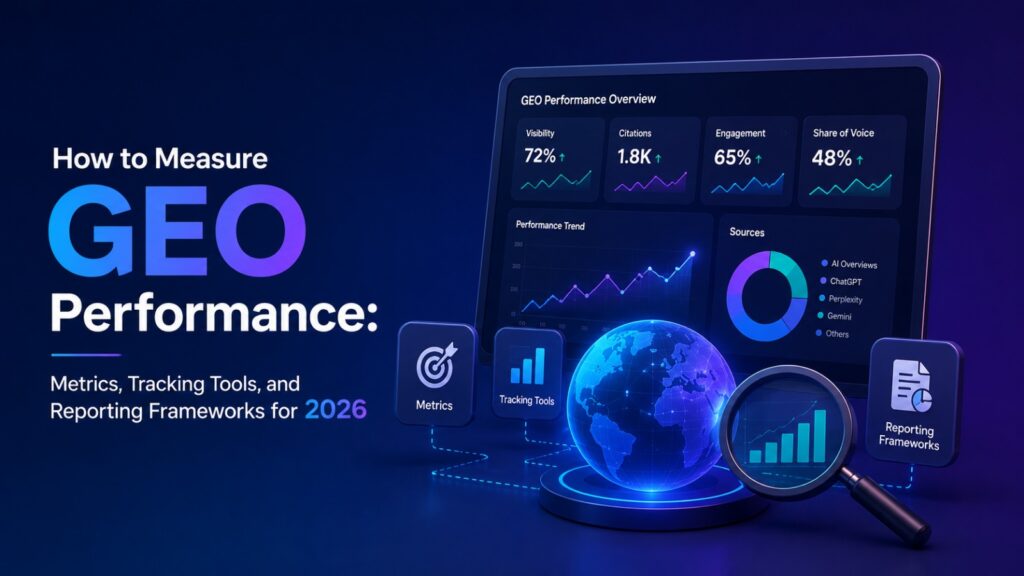
This guide explains the key GEO metrics, compares leading GEO analytics tools, and provides a practical framework for measuring AI search performance in 2026.
What Does It Mean to Measure GEO Performance?
Measuring GEO performance means evaluating how visible and influential your content is within AI-powered search systems.
Instead of focusing solely on rankings, GEO measurement focuses on questions such as:
- Does AI mention my brand?
- How often am I cited?
- Which content appears in AI answers?
- How much traffic comes from AI platforms?
- Is AI visibility increasing over time?
- Are AI-generated mentions influencing conversions?
The objective is to understand your brand’s presence across AI-driven discovery channels.
Why GEO Metrics Matter in 2026
AI search has transformed how users find information.
Many users now receive direct answers without clicking traditional search results.
As a result, marketers must measure visibility beyond organic rankings.
Benefits of GEO measurement include:
- Understanding brand exposure in AI search
- Identifying content that earns citations
- Tracking competitor visibility
- Improving content strategy
- Demonstrating marketing ROI
- Discovering emerging search opportunities
Organizations that measure GEO effectively can adapt faster than competitors who rely solely on traditional SEO reporting.
The Core GEO Metrics Every Marketer Should Track
Not all GEO metrics are equally important.
The most useful metrics help answer two questions:
- How visible is my brand in AI search?
- Is that visibility creating business value?
1. LLM Mention Rate
What Is LLM Mention Rate?
LLM Mention Rate measures how often a brand, website, product, or author appears in AI-generated responses.
Formula:
LLM Mentions ÷ Total Prompts Tested × 100
Example:
- 100 prompts analyzed
- Brand mentioned in 32 responses
LLM Mention Rate = 32%
This metric helps determine overall AI visibility.
Why It Matters
Higher mention rates often indicate stronger topical authority and better GEO performance.
2. AI Search Visibility Score
AI visibility measures how frequently your content appears across AI search platforms.
This includes:
- ChatGPT
- Gemini
- Claude
- Perplexity
- Copilot
A visibility score provides a broader view of AI presence than simple citation counts.
Example
Brand A:
Appears in 75% of tested prompts
Brand B:
Appears in 20% of tested prompts
Brand A demonstrates stronger AI search visibility.
3. Share of Voice (SOV) in AI Search
Share of Voice measures how much visibility your brand owns compared to competitors.
Example
Prompt Set:
Best GEO tools
Results:
- Brand A mentioned 45 times
- Brand B mentioned 30 times
- Brand C mentioned 15 times
Brand A owns the largest share of AI-generated discussion.
This metric is particularly useful for competitive analysis.
4. AI Citation Rate
Citation Rate measures how often AI systems reference or link to your content.
Why It Matters
AI mentions are valuable.
Citations are even more valuable.
A citation indicates that the AI system considers your content trustworthy enough to reference directly.
Track:
- Number of citations
- Citation frequency
- Most-cited content pages
- Citation trends over time
5. AI-Referred Traffic
AI visibility should ultimately generate business outcomes.
Monitor referral traffic from:
- ChatGPT
- Perplexity
- Gemini
- Copilot
- Claude integrations
Key metrics include:
- Sessions
- Users
- Engagement rate
- Time on page
- Conversion rate
This connects GEO activities to measurable results.
6. AI-Assisted Conversions
Traffic alone does not equal success.
Track whether AI-referred users:
- Purchase products
- Submit forms
- Request demos
- Subscribe to newsletters
- Download resources
This metric helps demonstrate GEO ROI.
The Most Important GEO KPIs to Monitor
| KPI | Purpose |
|---|---|
| LLM Mention Rate | Measures AI visibility |
| AI Citation Rate | Measures content authority |
| Share of Voice | Measures competitive position |
| AI Referral Traffic | Measures user acquisition |
| AI-Assisted Conversions | Measures business impact |
| Visibility Trend | Measures long-term growth |
For most organizations, these six metrics provide a complete GEO performance overview.
Best GEO Analytics Tools in 2026
The GEO software ecosystem is growing rapidly.
Several platforms now specialize in AI visibility tracking.
1. Profound
Best For
Enterprise GEO monitoring
Key Features
- AI citation tracking
- Brand visibility monitoring
- Competitor analysis
- Prompt-level reporting
- Share-of-voice measurement
Advantages
- Comprehensive reporting
- Strong enterprise capabilities
- Detailed AI visibility insights
Limitations
- Higher cost
- May be excessive for smaller businesses
2. Goodie AI
Best For
Content-focused GEO teams
Key Features
- Citation monitoring
- AI answer analysis
- Prompt tracking
- Content optimization insights
Advantages
- User-friendly interface
- Practical content recommendations
Limitations
- Smaller feature set than enterprise platforms
3. Gauge
Best For
Brand visibility tracking
Key Features
- AI search monitoring
- Competitor benchmarking
- Mention tracking
- Trend analysis
Advantages
- Strong visualization tools
- Useful competitive reporting
Limitations
- Limited content-level diagnostics
4. Peec AI
Best For
Growing marketing teams
Key Features
- LLM monitoring
- Prompt testing
- Brand mention tracking
- Visibility reporting
Advantages
- Easy implementation
- Useful performance dashboards
Limitations
- Newer platform with evolving feature set
5. Scrunch AI
Best For
Enterprise AI visibility management
Key Features
- AI search intelligence
- Citation analytics
- Competitive analysis
- Visibility reporting
Advantages
- Enterprise-ready capabilities
- Comprehensive AI monitoring
Limitations
- Higher learning curve
GEO Tools Comparison Table
| Tool | Best For | Mention Tracking | Citation Tracking | Competitor Analysis |
| Profound | Enterprise Brands | Yes | Yes | Yes |
| Goodie AI | Content Teams | Yes | Yes | Limited |
| Gauge | Visibility Analysis | Yes | Partial | Yes |
| Peec AI | Growing Teams | Yes | Partial | Yes |
| Scrunch AI | Enterprise GEO | Yes | Yes | Yes |
The right tool depends on budget, reporting needs, and team size.
How to Build a DIY GEO Tracking Spreadsheet
Not every organization needs premium GEO software.
A simple spreadsheet can provide valuable insights.
Recommended Columns
| Date | Prompt | Platform | Mentioned? | Citation? | Competitor Mentioned? |
Example:
| Jan 1 | Best GEO Tools | ChatGPT | Yes | Yes | Yes |
| Jan 1 | GEO Analytics Software | Gemini | No | No | Yes |
Over time, this data helps track:
- Mention frequency
- Visibility trends
- Competitive performance
- Citation growth
Even a basic spreadsheet can reveal valuable patterns.
How Often Should You Measure GEO Performance?
Most organizations should monitor GEO performance monthly.
Weekly Monitoring
Best for:
- Fast-moving industries
- Active content publishers
- Competitive niches
Monthly Monitoring
Best for:
- Most businesses
- Content marketing teams
- GEO reporting cycles
Quarterly Reviews
Best for:
- Strategic planning
- Budget allocation
- Long-term trend analysis
Consistency matters more than frequency.
Common GEO Reporting Mistakes
Many teams approach GEO reporting incorrectly.
Mistake 1: Focusing Only on Traffic
AI visibility often creates awareness before clicks occur.
Mistake 2: Ignoring Share of Voice
Competitor visibility provides important context.
Mistake 3: Measuring One AI Platform
Different AI systems produce different results.
Mistake 4: Tracking Mentions Without Conversions
Visibility alone does not prove business value.
Mistake 5: Expecting Immediate Results
GEO improvements often require sustained content development.
Building a GEO Dashboard for Executives
Executive stakeholders typically want concise reporting.
Include:
Visibility Metrics
- LLM Mention Rate
- Share of Voice
- Citation Rate
Traffic Metrics
- AI-referred sessions
- Engagement metrics
Business Metrics
- Leads
- Conversions
- Revenue influence
A dashboard that combines visibility and business outcomes creates a compelling GEO performance narrative.
The Future of GEO Analytics
GEO measurement is still evolving.
Over the next several years, marketers can expect:
- More accurate citation tracking
- Platform-specific AI reporting
- Enhanced visibility benchmarks
- Better attribution models
- AI-native analytics platforms
As AI search adoption increases, GEO reporting will likely become a standard component of digital marketing analytics.
Conclusion
As AI-powered search becomes a major discovery channel, marketers must move beyond traditional SEO metrics and adopt GEO-focused measurement frameworks.
Tracking LLM Mention Rate, AI search visibility, citation frequency, Share of Voice, and AI-referred conversions provides a clearer understanding of how content performs within modern search ecosystems.
Whether you use enterprise tools such as Profound and Scrunch AI or build a simple tracking spreadsheet, the key is consistency. The brands that measure GEO performance effectively will be better positioned to improve visibility, demonstrate ROI, and compete successfully in the AI search era.
Frequently Asked Questions
What is GEO performance?
GEO performance measures how visible and influential a brand or content is within AI-powered search systems and large language models.
What is LLM Mention Rate?
LLM Mention Rate measures how often a brand appears in AI-generated responses compared to the total number of prompts analyzed.
How can I track AI search visibility?
AI search visibility can be tracked using GEO analytics tools, manual prompt testing, citation monitoring, and AI referral traffic analysis.
What is Share of Voice in AI search?
Share of Voice measures how often a brand appears compared to competitors across AI-generated responses.
Which GEO metric is most important?
Most experts consider LLM Mention Rate, AI Citation Rate, Share of Voice, and AI-Referred Traffic to be the most valuable GEO metrics.
Are GEO analytics tools worth using?
For organizations investing heavily in AI search visibility, GEO analytics tools can provide valuable insights into brand presence, content performance, and competitive positioning.
Can Google Analytics track AI traffic?
Yes. Many AI platforms generate referral traffic that can be monitored using analytics platforms and custom reporting segments.