
Introduction
As AI-powered search platforms become more influential, simply publishing content is no longer enough.
Today, AI systems are increasingly focused on determining not only what information is being shared but also who is providing that information.
This shift has made expertise, credibility, and trust more important than ever.
When users ask ChatGPT, Gemini, Perplexity, Claude, or other AI assistants complex questions, these systems often prioritize information from sources that demonstrate authority and expertise. In many cases, the reputation of the author behind the content can influence how trustworthy that information appears.
This is where E-E-A-T becomes critical.
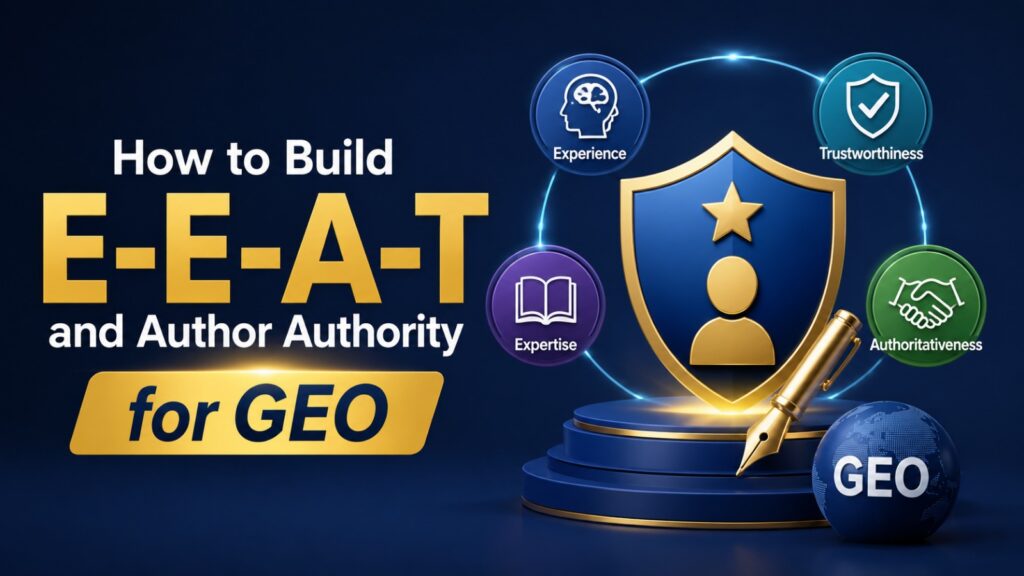
Originally introduced within Google’s Search Quality Evaluator Guidelines, E-E-A-T stands for Experience, Expertise, Authoritativeness, and Trustworthiness. While AI search systems operate differently from traditional search engines, many of the same credibility signals remain highly valuable.
For GEO practitioners, building author authority is no longer optional. It is becoming a core visibility strategy.
In this guide, you’ll learn how E-E-A-T applies to AI search, why author authority matters for GEO, and the practical steps you can take to build a digital footprint that both users and AI systems recognize as trustworthy.
What Is E-E-A-T?
E-E-A-T stands for:
Experience
Has the author personally worked with, tested, or experienced the topic being discussed?
Expertise
Does the author possess relevant knowledge and subject-matter understanding?
Authoritativeness
Is the author or brand recognized as a respected source within the industry?
Trustworthiness
Can users trust the information, claims, and recommendations being provided?
Together, these signals help evaluate content quality.
Although E-E-A-T is not a direct ranking factor, it influences how search engines and AI systems assess credibility.
Why E-E-A-T Matters for GEO
Generative Engine Optimization focuses on increasing visibility within AI-generated responses.
To generate accurate answers, AI systems need confidence in the sources they reference.
This creates a natural preference for:
- Recognized experts
- Trusted organizations
- Well-established brands
- Credible publishers
- Experienced practitioners
When multiple sources provide similar information, authority signals can influence which sources receive greater attention.
For this reason, GEO is not just about content optimization.
It is also about reputation optimization.
How AI Search Evaluates Authority
AI search systems do not simply count backlinks or keyword usage.
Instead, they often evaluate broader credibility signals.
These may include:
Author Identity
Can the author be clearly identified?
Professional Background
Does the author have relevant expertise?
Brand Reputation
Is the organization recognized within its field?
Third-Party Mentions
Do other trusted websites reference the author or brand?
Content Consistency
Has the author demonstrated expertise repeatedly over time?
The stronger these signals become, the easier it is for AI systems to associate your content with authority.
Why Author Authority Matters More Than Ever
In traditional SEO, a website could sometimes rank without a visible author.
In AI search, anonymous content may face increasing challenges.
AI systems are becoming better at understanding entities and relationships.
An author is an entity.
A company is an entity.
A topic is an entity.
When these entities become strongly connected, authority grows.
For example:
If a GEO consultant consistently publishes articles about:
- AI search
- GEO strategies
- AI citations
- Retrieval systems
- LLM optimization
AI systems begin associating that individual with GEO expertise.
Over time, this can strengthen visibility opportunities.
The Role of Experience in GEO
Experience is the first “E” in E-E-A-T and often the most overlooked.
Experience demonstrates that content comes from real-world involvement rather than theory alone.
Examples include:
- Case studies
- Client results
- Testing methodologies
- Personal experiments
- Original research
Instead of simply explaining GEO concepts, show how you applied them.
For example:
“We implemented FAQ schema on 25 client pages and observed an increase in AI visibility signals over six months.”
Specific experiences create stronger credibility than generic advice.
Creating Strong Author Bios
One of the simplest GEO improvements is enhancing author biographies.
Many websites include only a name and profile picture.
This is a missed opportunity.
An effective author bio should include:
Professional Role
Explain what the author does.
Industry Experience
Highlight relevant expertise.
Areas of Specialization
Clarify subject-matter focus.
Credentials
Mention certifications, education, or achievements when relevant.
Published Work
Link to additional content written by the author.
Social Profiles
Connect verified professional profiles.
The goal is to help both users and machines understand who created the content.
Building Topical Authority Around a Single Subject
Authority grows faster when expertise is concentrated.
Many creators dilute authority by publishing content across unrelated topics.
Instead, focus on a clearly defined niche.
For ExplainGeo, this means creating comprehensive coverage around:
- GEO fundamentals
- AI visibility
- AI search engines
- LLM retrieval
- AI citations
- Structured data
- AI content optimization
The more comprehensive your topic coverage becomes, the stronger your authority signals grow.
How Third-Party Mentions Strengthen Authority
Authority is not built solely on your own website.
External validation matters.
Third-party mentions act as credibility signals.
Examples include:
Guest Articles
Publishing on respected industry websites.
Podcast Appearances
Sharing expertise through interviews.
Conference Speaking
Presenting at marketing or AI events.
Expert Roundups
Contributing insights alongside other professionals.
Media Coverage
Being quoted in industry publications.
These activities help establish recognition beyond your own platform.
The Importance of Entity Recognition
Modern AI systems increasingly understand the world through entities.
An entity can be:
- A person
- A company
- A product
- A concept
The more consistently your name appears alongside GEO-related topics, the stronger your topical association becomes.
For example:
If ExplainGeo repeatedly publishes content covering:
- GEO
- AI citations
- AI visibility
- Retrieval systems
- AI search optimization
AI systems become more likely to associate the brand with those topics.
Consistency matters.
How to Build a Recognizable Digital Footprint
A digital footprint is the collection of information about you across the internet.
Strong authority often comes from consistency.
Ensure that:
Your Author Name Is Consistent
Avoid using multiple variations.
Bios Match Across Platforms
Maintain similar professional descriptions.
Profiles Are Updated
Keep credentials current.
Expertise Is Clearly Defined
Focus on your niche.
Content Themes Remain Consistent
Avoid publishing unrelated content that weakens topical associations.
Over time, these signals strengthen entity recognition.
Common Mistakes That Hurt Author Authority
Many websites unintentionally weaken their credibility.
Avoid these common issues.
Anonymous Content
Missing author information reduces transparency.
Generic Bios
Vague descriptions provide little value.
No Supporting Credentials
Expertise should be demonstrated where appropriate.
Inconsistent Branding
Different names and descriptions create confusion.
Publishing Outside Your Expertise
Covering unrelated topics can dilute authority.
Lack of Original Insights
Rewriting existing content rarely establishes expertise.
GEO Strategies for Building Authority Faster
If your goal is to accelerate authority growth, focus on these actions.
Publish Consistently
Regular content reinforces expertise.
Create Original Research
Unique data attracts citations and mentions.
Develop Topic Clusters
Cover subjects comprehensively.
Earn Industry Mentions
Seek opportunities for external recognition.
Showcase Experience
Share real examples and lessons learned.
Build Personal Brands
Invest in both company and author visibility.
Authority compounds over time.
The earlier you start, the greater the long-term advantage.
The Future of E-E-A-T in AI Search
As AI systems become more sophisticated, evaluating credibility will become increasingly important.
Future AI search experiences will likely place greater emphasis on:
- Expert authorship
- Verified identities
- Entity relationships
- Original research
- Trust signals
- Reputation networks
Websites that invest in authority today will be better positioned as AI search continues evolving.
The trend is clear.
The internet is moving toward a trust-first ecosystem.
Conclusion
Building E-E-A-T and author authority is no longer just an SEO best practice. It is becoming a critical GEO strategy.
AI systems need trustworthy sources to generate reliable answers. As a result, expertise, experience, authority, and trust play an increasingly important role in determining which content receives attention.
By creating strong author profiles, publishing within a focused niche, earning third-party recognition, and consistently demonstrating expertise, you can build a digital footprint that both users and AI systems recognize as authoritative.
In the age of AI search, credibility is a competitive advantage.
The brands and authors that invest in it today will be the ones most likely to earn visibility tomorrow.
Frequently Asked Questions
What does E-E-A-T stand for?
E-E-A-T stands for Experience, Expertise, Authoritativeness, and Trustworthiness.
Why is E-E-A-T important for GEO?
AI systems often favor content from credible and authoritative sources when generating responses.
Does author authority affect AI citations?
Strong author authority can improve trust signals, making content more likely to be viewed as credible.
What should an author bio include?
An effective bio should include experience, expertise, professional background, and relevant credentials.
How can I build topical authority?
Focus on publishing comprehensive content around a specific niche rather than covering unrelated subjects.
Do third-party mentions help GEO?
Yes. Mentions from trusted websites, publications, and industry sources strengthen authority signals.
Can new authors build authority?
Absolutely. Consistent publishing, expertise, and original insights can gradually build credibility over time.
What is the most important GEO authority signal?
There is no single factor, but demonstrated expertise combined with trust and topical consistency is often the strongest foundation.
Logo Link: https://www.explaingeo.com/wp-content/uploads/elementor/thumbs/explaingeo-1-1-e1773679139650-rklnu9zh7uoy05n34xlbvs860nxamuqdjyfm76q02w.png
Blog Image: https://www.explaingeo.com/wp-content/uploads/2026/06/how-to-build-e-e-a-t-and-author-authority-for-geo-1024×576.jpeg
Blog URL: https://www.explaingeo.com/how-to-build-e-e-a-t-and-author-authority-for-geo/
Blog Title: How to Build E-E-A-T and Author Authority for GEO
Please make a article schema also make faqs schema separate please make both schema’s with the starting and ending tags
Frequently Asked Questions
What does E-E-A-T stand for?
E-E-A-T stands for Experience, Expertise, Authoritativeness, and Trustworthiness.
Why is E-E-A-T important for GEO?
AI systems often favor content from credible and authoritative sources when generating responses.
Does author authority affect AI citations?
Strong author authority can improve trust signals, making content more likely to be viewed as credible.
What should an author bio include?
An effective bio should include experience, expertise, professional background, and relevant credentials.
How can I build topical authority?
Focus on publishing comprehensive content around a specific niche rather than covering unrelated subjects.
Do third-party mentions help GEO?
Yes. Mentions from trusted websites, publications, and industry sources strengthen authority signals.
Can new authors build authority?
Absolutely. Consistent publishing, expertise, and original insights can gradually build credibility over time.
What is the most important GEO authority signal?
There is no single factor, but demonstrated expertise combined with trust and topical consistency is often the strongest foundation.
Pingback: AI Citation Optimization: 25-Point GEO Content Checklist