
Introduction
As AI-powered search platforms continue to transform how people discover information online, marketers are asking a critical question:
“How do Large Language Models (LLMs) actually find and choose content?”
Most website owners understand how traditional search engines work. Search engines crawl pages, index content, and rank results based on hundreds of signals.
AI search operates differently.
When someone asks ChatGPT, Gemini, Perplexity, Claude, or another AI assistant a question, the system often does far more than simply retrieve a webpage. Instead, it gathers information from multiple sources, evaluates relevance, synthesizes answers, and sometimes cites the sources it used.
Understanding this process is essential for anyone investing in Generative Engine Optimization (GEO).
In this guide, we’ll break down query fan-out, Retrieval-Augmented Generation (RAG), content retrieval, citation selection, and LLM ranking systems in plain English—without requiring a technical background.
Why Understanding Retrieval Matters
Many marketers focus only on content creation.
However, content quality alone doesn’t guarantee visibility in AI-generated answers.
To be surfaced by AI systems, your content must first be:
- Discoverable
- Understandable
- Relevant
- Trustworthy
- Easy to extract
Understanding how retrieval works helps explain why some websites are frequently cited while others are rarely mentioned.
Once you understand the retrieval process, GEO becomes much more strategic.
The Traditional Search Process vs AI Search
Let’s start with a simple comparison.
Traditional Search
When a user searches Google:
- Google receives the query.
- It searches its index.
- Pages are ranked.
- Users choose a result.
The search engine’s job is primarily to rank webpages.
AI Search
When a user asks an AI assistant:
“How do I improve my website’s AI visibility?”
The system often:
- Interprets intent.
- Expands the query.
- Retrieves multiple sources.
- Compares information.
- Generates an answer.
- May include citations.
The goal is not simply ranking pages.
The goal is generating the best possible answer.
This distinction changes everything.
What Happens When Someone Asks an AI a Question?
Let’s follow a real example.
User query:
“How can a small business get cited by ChatGPT?”
At first glance, this seems like a straightforward question.
However, modern AI systems often transform that question into multiple retrieval requests behind the scenes.
Instead of searching for only one phrase, they may look for:
- AI citation strategies
- GEO best practices
- AI search optimization
- Content authority signals
- Structured data implementation
- ChatGPT citation methods
This process is called query expansion.
It helps AI systems gather a broader and more complete set of information.
Understanding Query Fan-Out
One of the most important concepts in AI search is query fan-out.
Most marketers have never heard the term, but it plays a major role in content discovery.
What Is Query Fan-Out?
Query fan-out occurs when an AI system transforms one user query into multiple related searches.
Instead of retrieving information from a single search request, the AI creates several searches simultaneously.
Example:
User asks:
“How does GEO work?”
The system may internally search for:
- Generative Engine Optimization
- AI search optimization
- AI citation ranking
- LLM content retrieval
- Content visibility in ChatGPT
- AI search algorithms
One question becomes many.
This helps the system gather more comprehensive information.
Why Query Fan-Out Matters for GEO
Query fan-out means your content doesn’t need to rank for the exact phrase users type.
Instead, it may be discovered through related concepts.
This is why topical authority is so important.
A website covering:
- GEO fundamentals
- Schema markup
- AI citations
- RAG systems
- LLM retrieval
has more opportunities to appear across expanded query sets.
Comprehensive coverage increases visibility.
What Is Retrieval-Augmented Generation (RAG)?
Another essential concept is Retrieval-Augmented Generation.
Often abbreviated as RAG, it powers many modern AI search experiences.
Simple Definition
RAG combines:
- Information retrieval
- AI-generated responses
Instead of relying entirely on training data, the AI retrieves fresh information before generating an answer.
Think of it like an open-book exam.
The AI can consult external information sources before responding.
How RAG Works
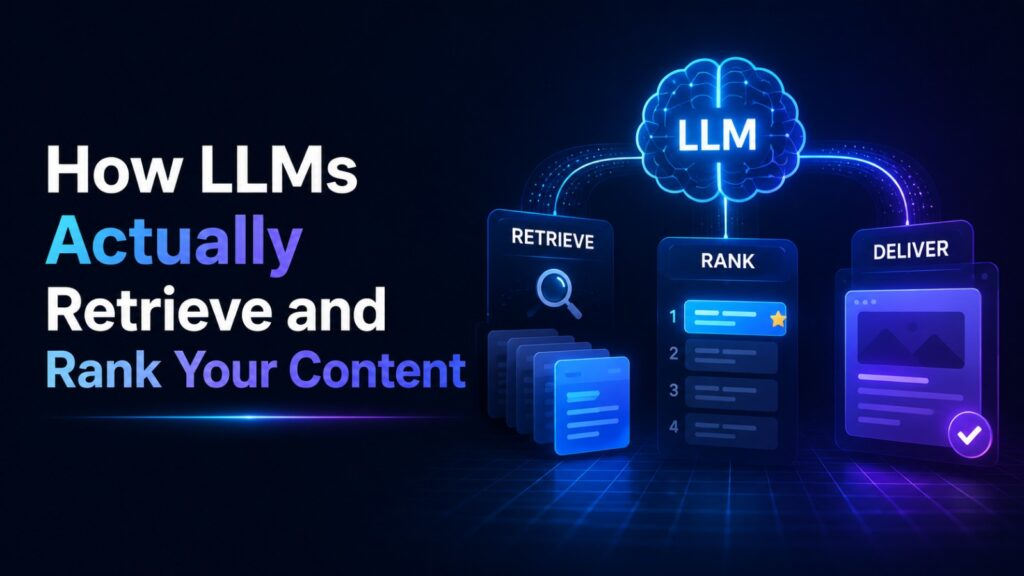
A simplified RAG process looks like this:
User Question
↓
Query Expansion
↓
Source Retrieval
↓
Content Evaluation
↓
Answer Generation
↓
Citation Selection
The retrieval step is where your content has an opportunity to appear.
If your page is relevant and authoritative, it may be included in the retrieved information set.
Why RAG Changed Search
Before retrieval systems became common, AI models relied primarily on information learned during training.
This created limitations:
- Outdated information
- Missing facts
- Reduced accuracy
RAG improves results by introducing real-time or recently indexed information.
Benefits include:
- Better accuracy
- More current information
- Stronger source attribution
- Improved trustworthiness
This is why GEO has become increasingly important.
Your content can now influence answers after publication.
How AI Systems Evaluate Retrieved Content
Once content is retrieved, not every source receives equal treatment.
The AI system evaluates information using several signals.
Relevance
The content must closely match user intent.
Pages that directly answer questions perform better than vague or unrelated content.
Authority
Authority signals include:
- Brand reputation
- Author expertise
- Industry recognition
- Backlinks
- Citations
Trusted sources often receive greater weighting.
Clarity
AI systems prefer content that is easy to interpret.
Helpful formats include:
- Definitions
- Lists
- Tables
- FAQs
- Step-by-step instructions
Clear formatting improves extractability.
Freshness
For evolving topics, newer information may be prioritized.
Outdated content can become less competitive over time.
How Citation Selection Works
One of the biggest misconceptions in GEO is that every retrieved page gets cited.
That’s not how AI search works.
Many pages may contribute information.
Only a few receive visible citations.
Why Certain Pages Get Cited
AI systems often favor pages that provide:
- Direct answers
- Original insights
- Strong authority
- Clear supporting evidence
- Well-structured information
Citation-worthy content is typically easier to verify and summarize.
What Makes Content Easy for LLMs to Use?
Content designed for human readers generally performs best.
However, certain formatting choices help AI systems understand information more effectively.
Strong Headings
Use descriptive H2 and H3 headings.
Direct Answers
Provide concise answers immediately below questions.
FAQ Sections
Question-and-answer formats align naturally with AI retrieval.
Lists and Bullet Points
These improve extraction accuracy.
Definitions
Clear definitions often become citation candidates.
Entity Signals
Mention relevant concepts consistently.
For GEO topics, examples include:
- AI search
- LLMs
- Retrieval systems
- Schema markup
- Content authority
Common Reasons Content Is Ignored
Many websites create content that never appears in AI-generated answers.
Common issues include:
Thin Content
Short articles with limited value rarely stand out.
Poor Structure
Large text blocks are difficult to process.
Weak Authority Signals
Missing author information can reduce trust.
Limited Topic Coverage
Surface-level content often loses to comprehensive resources.
Excessive Promotion
Sales-heavy content may appear less trustworthy.
GEO Strategies Based on Retrieval Mechanics
Understanding retrieval leads directly to better GEO decisions.
Build Topic Clusters
Cover related concepts comprehensively.
Create Citation-Friendly Content
Use definitions, FAQs, and structured explanations.
Implement Schema Markup
Help machines understand content context.
Demonstrate Expertise
Show who created the content and why they are qualified.
Keep Content Updated
Fresh information remains competitive.
Publish Original Research
Unique insights increase citation potential.
The Future of AI Content Retrieval
Retrieval systems continue evolving rapidly.
Future AI search experiences will likely place greater emphasis on:
- Source quality
- Entity relationships
- Expert authorship
- Structured data
- Real-time information
As retrieval improves, websites with strong topical authority and clear information architecture will have a significant advantage.
The fundamentals of GEO will remain centered on trust, expertise, and content quality.
Conclusion
Understanding how LLMs retrieve and rank content is one of the most important skills in modern digital marketing.
AI systems do not simply rank webpages the way traditional search engines do. Instead, they expand queries, retrieve information from multiple sources, evaluate authority, and generate answers designed to satisfy user intent.
Concepts like query fan-out, Retrieval-Augmented Generation (RAG), relevance evaluation, and citation selection explain why some websites consistently appear in AI-generated answers while others remain invisible.
For marketers and publishers, the takeaway is clear: create authoritative, structured, and comprehensive content that is easy for both humans and machines to understand.
The better your content supports retrieval, the greater your chances of being surfaced and cited across the growing AI search ecosystem.
Frequently Asked Questions
What is Retrieval-Augmented Generation (RAG)?
RAG is a framework that combines information retrieval with AI-generated responses, allowing models to use external information when answering questions.
What is query fan-out in AI search?
Query fan-out is the process of expanding a single user query into multiple related searches to gather more comprehensive information.
How do LLMs retrieve content?
LLMs retrieve content through search systems, retrieval databases, indexes, and external information sources before generating answers.
Do AI systems rank websites like Google?
Not exactly. AI systems prioritize information retrieval and answer generation rather than simply ranking webpages.
Why do some websites get cited more often?
Websites with strong authority, clear structure, topical expertise, and trustworthy information are more likely to be cited.
What makes content easy for AI systems to use?
Clear headings, concise answers, FAQs, structured formatting, and strong topical relevance improve extractability.
Does schema markup help retrieval?
Schema markup can help machines better understand content and improve contextual interpretation.
What is the most important GEO strategy?
Building topical authority through comprehensive, high-quality content remains one of the most effective GEO strategies.