
Introduction
AI is changing how content is created and ranked. What once required hours of manual writing, keyword research, and optimization can now be done in minutes with the help of advanced AI tools. This shift is not just about speed—it’s about transforming how content aligns with search intent and performs in search engines.
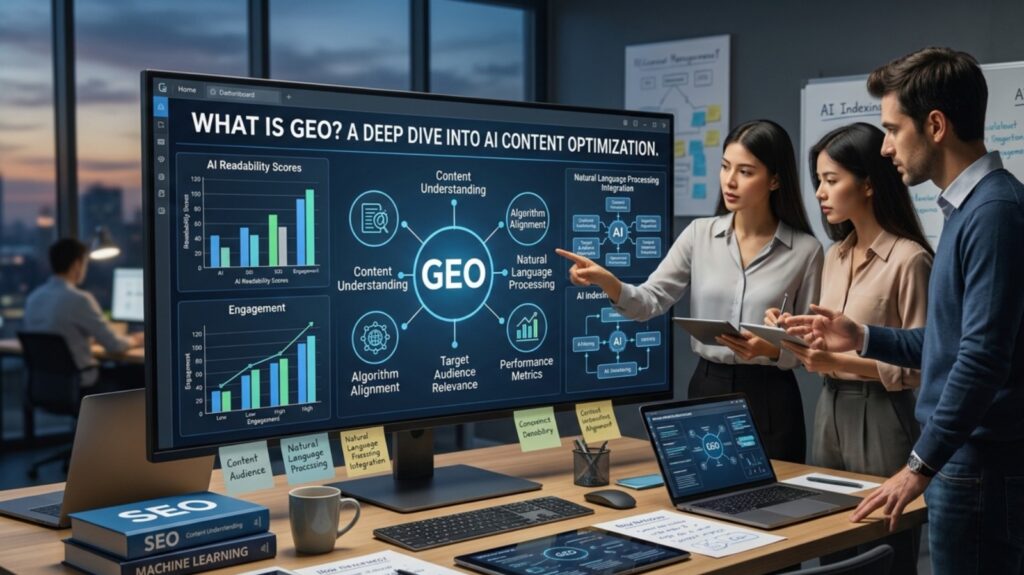
As search algorithms evolve and user behavior becomes more intent-driven, traditional methods alone are no longer enough. This is where Generative Engine Optimization (GEO) comes in as a modern solution. GEO focuses on optimizing AI-generated content so it not only ranks faster but also scales efficiently across multiple topics while maintaining relevance and quality.
At Explain GEO, we break down how AI-driven content strategies are shaping the future of search. Our goal is to help marketers, creators, and businesses understand how to leverage GEO to stay competitive in an AI-powered digital landscape.
Learn more in our GEO introduction guide to understand the fundamentals before diving deeper into advanced strategies.
What is GEO?
Generative Engine Optimization (GEO) is the practice of optimizing AI-generated content to rank higher in search engines while delivering valuable, relevant information to your audience. Unlike traditional SEO, which relies primarily on keywords, backlinks, and meta tags, or AEO, which focuses on answering specific questions for featured snippets and voice search, GEO integrates the power of AI to create content that is intent-driven, scalable, and highly relevant.
In simple terms:
GEO is the process of ensuring AI-generated content aligns with what users are searching for, ranks faster, and can scale across multiple topics efficiently.
Why GEO Matters
- Speed: AI can generate content in minutes, but GEO ensures it ranks effectively.
- Relevance: GEO aligns content with search intent, increasing user engagement.
- Scalability: Create content clusters covering multiple keywords and topics with minimal manual effort.
At Explain GEO, we show marketers how to implement GEO strategies effectively, combining AI tools, SEO principles, and AEO techniques to produce content that not only ranks but also provides genuine value to readers.
How GEO Works

Generative Engine Optimization (GEO) works by combining AI content generation with search intent alignment and strategic content structuring. The goal is to produce AI-generated content that not only scales but also ranks higher and delivers value. Let’s break down the key components:
3.1 AI Content Generation
AI engines like ChatGPT, Jasper, and Bard can create content in minutes that previously would have taken hours. GEO ensures that this content is not just generated quickly but is also optimized for search engines.
Key Practices:
- Use AI tools to draft articles, FAQs, or product descriptions.
- Provide clear prompts that specify the topic, audience, and tone.
- Focus on quality output rather than just quantity.
Example:
Prompt:
“Write a 1,000-word blog post on GEO for marketers, including tips for ranking AI-generated content.”
With GEO, AI produces content aligned with what users are actively searching for, ready to be structured and optimized.
3.2 Search Intent Alignment
Search engines prioritize content that meets user intent. GEO ensures AI-generated content addresses why users search for a topic, not just what they search for.
Best Practices:
- Identify the search intent (informational, navigational, or transactional).
- Align content headings and paragraphs with intent.
- Use FAQs, lists, and clear answers to satisfy snippet opportunities.
Snippet-ready Example:
Users searching for “What is GEO?” are looking for a clear definition, benefits, and practical applications. GEO ensures your content answers these questions directly.
3.3 Content Structuring
Even AI-generated content needs a proper SEO-friendly structure. GEO integrates best practices for headings, formatting, and internal linking to boost rankings.
Key Tips:
- Use H1, H2, and H3 headings to organize topics.
- Naturally include primary and related keywords.
- Add internal and external links to build authority.
- Ensure readability for snippet potential.
Example Structure for GEO Article:
- H1: What is GEO? A Deep Dive
- H2: How GEO Works
- H3: AI Content Generation
- H3: Search Intent Alignment
- H3: Content Structuring
3.4 Scaling and Cluster Creation
GEO is powerful because it enables scalable content creation. By building content clusters, you can target multiple keywords while reinforcing topical authority.
Cluster Example:
- Pillar Article: “What is GEO?”
- Supporting Articles:
- “GEO vs SEO vs AEO”
- “Top AI Tools for GEO Content”
- “Optimizing AI Content for Search Engines”
This approach improves internal linking, signals relevance to search engines, and allows AI-generated content to scale efficiently.
Key Components of GEO
Generative Engine Optimization (GEO) relies on several core components that work together to ensure AI-generated content ranks faster, aligns with search intent, and scales efficiently. Let’s explore the main building blocks:
4.1 Prompt Engineering
The quality of AI-generated content starts with the prompt. Prompt engineering is about writing clear, detailed instructions so the AI produces content that meets your goals.
Best Practices:
- Include topic, audience, and format in the prompt.
- Specify tone, length, and keywords.
- Test and refine prompts for better output.
Example Prompt:
“Write a 1,500-word blog post on the benefits of GEO for marketers. Include examples, headings, FAQs, and internal links to related articles.”
Why it matters:
- AI outputs content aligned with search intent.
- Reduces manual editing time.
- Helps scale content across multiple topics quickly.
4.2 Content Structuring
Even the best AI content needs proper structure for SEO and readability. GEO ensures content is easy for search engines and users to digest.
Best Practices:
- Use H1, H2, H3 headings for hierarchy.
- Break content into short paragraphs for readability.
- Include lists, tables, and FAQs for snippet potential.
- Use internal linking to related pillar or cluster articles.
Example:
- H1: What is GEO?
- H2: Key Components of GEO
- H3: Prompt Engineering
- H3: Content Structuring
- H3: Scaling and Clusters
4.3 Content Scaling
GEO enables content production at scale without compromising quality. By leveraging AI tools, you can create multiple articles around a central topic, covering long-tail keywords efficiently.
Best Practices:
- Identify content clusters around a pillar topic.
- Generate multiple AI drafts, then edit for consistency and relevance.
- Track performance and iterate for better rankings.
Example Cluster for GEO:
- Pillar: “What is GEO?”
- Supporting: “GEO vs SEO vs AEO”
- Supporting: “Top AI Tools for GEO Content”
- Supporting: “Optimizing AI Content for Search Engines”
4.4 Continuous Optimization
GEO is not a one-time task. Continuous monitoring ensures AI content remains relevant, accurate, and high-performing.
Best Practices:
- Update content based on new trends and algorithm changes.
- Refine AI prompts over time for better output.
- Audit internal links and keywords regularly.
- Check for plagiarism and AI detection issues.
GEO vs Traditional Content Optimization
Generative Engine Optimization (GEO) differs significantly from traditional SEO and AEO methods. Understanding these differences helps marketers decide when to leverage AI-driven content strategies versus conventional approaches.
| Feature | SEO (Search Engine Optimization) | AEO (Answer Engine Optimization) | GEO (Generative Engine Optimization) |
| Focus | Keywords, backlinks, and page authority | Providing direct answers for snippets and voice search | Aligning AI-generated content with search intent and scaling efficiently |
| Content Style | Static, human-written | Concise, FAQ-style | AI-generated, intent-focused |
| Speed | Moderate | Fast | Very fast |
| Scalability | Medium | Medium | High |
| Best Use Case | Blog posts, long-form content, traditional ranking | FAQs, featured snippets, voice search | AI-generated blogs, scalable content clusters |
Key Takeaways
- SEO focuses on traditional ranking factors like keywords, backlinks, and technical optimization. It works best for long-form human-written content but can be time-consuming and less scalable.
- AEO targets question-based queries and snippets, making it ideal for voice search and featured boxes. However, it does not fully leverage AI content creation.
- GEO combines AI capabilities with intent-driven strategies. It enables faster content creation, easier scaling across multiple topics, and optimization for both search engines and user intent.
Snippet-ready Insight:
“GEO allows AI-generated content to scale quickly while staying aligned with what users are actively searching for, unlike traditional SEO or AEO methods.”
Benefits of GEO
Generative Engine Optimization (GEO) offers several advantages over traditional content methods, particularly when leveraging AI-generated content for search engines. Implementing GEO strategies can help businesses and content creators achieve faster rankings, higher relevance, and scalable content production.
1. Faster Content Production
AI engines can generate high-quality drafts in minutes, but GEO ensures that this content is optimized for search intent and structure. This reduces manual editing and speeds up the overall content creation process.
Example:
- Instead of spending hours writing a blog post from scratch, GEO-guided AI can produce a well-structured draft ready for optimization.
2. Improved Ranking Speed
By aligning AI content with search intent and optimizing structure, GEO helps content rank faster in search results. Proper heading hierarchy, keyword placement, and snippet-ready formatting give content a competitive edge.
Snippet-ready insight:
“GEO ensures AI-generated content aligns with what users search for, increasing its chances of ranking faster.”
3. Scalability Across Topics
GEO enables businesses to produce multiple AI-generated articles around a central pillar topic. This content cluster approach allows brands to cover more long-tail keywords and topics without manually writing every article.
Example Cluster:
- Pillar: “What is GEO?”
- Supporting: “GEO vs SEO vs AEO”
- Supporting: “Top AI Tools for GEO Content”
- Supporting: “Optimizing AI Content for Search Engines”
4. Better Targeting of Long-Tail Queries
Long-tail keywords are often overlooked in traditional SEO due to time constraints. GEO allows AI to generate content targeting specific queries, improving visibility for niche searches and attracting highly relevant traffic.
Benefit:
- More precise audience targeting
- Higher engagement and lower bounce rates
5. Enhanced Efficiency and Consistency
By combining AI with structured optimization practices, GEO ensures content maintains consistent quality, tone, and format across multiple articles. This is especially useful for brands managing large content volumes.
Challenges of GEO (H2)
While Generative Engine Optimization (GEO) offers significant advantages, it also comes with challenges that marketers and content creators should be aware of. Understanding these obstacles helps ensure AI-generated content remains high-quality, relevant, and compliant with search engine standards.
1. Maintaining Content Quality
AI can generate content quickly, but not all output meets human-quality standards. Errors, awkward phrasing, or incomplete explanations may occur without careful editing.
Best Practices:
- Review AI drafts thoroughly for accuracy and readability.
- Use AI-generated content as a foundation rather than a final product.
- Incorporate human insights, examples, and context to enrich content.
2. Avoiding AI Detection Issues
Some search engines and platforms may flag content that appears fully AI-generated. Overreliance on AI without proper optimization can reduce trustworthiness or affect rankings.
Best Practices:
- Edit AI content to add unique phrasing and brand voice.
- Include human examples or case studies where possible.
- Balance AI efficiency with human oversight.
3. Plagiarism Risks
AI sometimes unintentionally mirrors existing content, which can lead to duplicate content issues or copyright concerns.
Best Practices:
- Run AI-generated drafts through plagiarism checkers.
- Rewrite and restructure any content flagged as similar to existing sources.
- Cite credible sources when necessary to enhance authority.
4. Aligning AI Output with Search Intent
Without proper guidance, AI content may not fully satisfy the intent behind a search query, reducing its chances of ranking effectively.
Best Practices:
- Optimize prompts to reflect specific user intent.
- Structure content with headings, FAQs, and lists for clarity.
- Use analytics to track which articles meet user needs and adjust accordingly.
5. Keeping Up with Algorithm Changes
Search engines are constantly evolving. Content that ranks well today may require updates tomorrow. GEO requires continuous monitoring and optimization.
Best Practices:
- Regularly update AI-generated content for relevance.
- Refine keywords and headings based on search trends.
- Maintain content clusters to strengthen topical authority.
GEO Implementation Checklist
Implementing Generative Engine Optimization (GEO) can seem complex, but following a structured checklist ensures that your AI-generated content ranks faster, scales efficiently, and aligns with search intent.
1. Define Search Intent for Each Article
- Identify whether the content is informational, transactional, or navigational.
- Focus on what users expect to learn or achieve from your article.
- Align AI prompts or content outlines accordingly.
2. Optimize AI Prompts for Keywords and Queries
- Include primary and related keywords in your instructions.
- Specify audience, tone, and format for the AI content.
- Example:
“Write a 1,200-word blog on GEO for marketers, including definitions, benefits, and FAQs.”
3. Use Structured Headings for Readability
- Organize content using H1, H2, and H3 headings.
- Break information into short paragraphs and lists for clarity.
- Ensure headings include keywords naturally for SEO.
4. Build Supporting Cluster Articles
- Create pillar content around a main topic.
- Develop supporting cluster articles targeting related keywords and subtopics.
- Link all cluster articles internally to strengthen topical authority.
5. Monitor AI Content for Quality and Relevance
- Review drafts for accuracy, readability, and tone.
- Update content based on analytics and user feedback.
- Check for plagiarism and avoid over-reliance on generic AI phrases.
Snippet-ready Insight:
“A successful GEO strategy combines AI efficiency with search intent alignment, structured content, and continuous quality monitoring.”
Conclusion
Generative Engine Optimization (GEO) is transforming how content is created, optimized, and ranked. By combining AI-generated content with strategic search intent alignment, structured formatting, and content clustering, GEO allows businesses and creators to:
- Rank faster in search results by targeting user intent.
- Scale content production efficiently across multiple topics.
- Target long-tail queries for more precise audience engagement.
- Maintain consistent quality while leveraging AI speed.
Unlike traditional SEO or AEO, GEO integrates AI capabilities directly into your content strategy, providing a smarter, more efficient approach to digital marketing.
FAQs:
What is GEO?
Generative Engine Optimization (GEO) is the process of optimizing AI-generated content to rank effectively in search engines while delivering valuable, relevant information to users. GEO ensures content aligns with search intent, scales across multiple topics, and maintains quality.
How is GEO different from SEO and AEO?
- SEO focuses on keywords, backlinks, and technical optimization for traditional ranking.
- AEO targets direct answers, snippets, and voice search queries.
- GEO combines AI content generation with search intent alignment, content structuring, and scalable production across multiple topics.
Why is GEO important for content marketing?
GEO allows marketers to produce AI-generated content that:
- Ranks faster in search results
- Covers multiple topics efficiently
- Targets long-tail queries for precise audience engagement
- Maintains consistent quality and readability
How does GEO work with AI content generators?
GEO integrates AI engines like ChatGPT, Jasper, or Bard with:
- Prompt engineering for clear, intent-driven instructions
- Content structuring using H1-H3 headings, lists, and FAQs
- Content clusters to target multiple keywords and reinforce topical authority
What is prompt engineering in GEO?
Prompt engineering involves writing clear, detailed instructions for AI to produce content that aligns with your goals. Effective prompts include: topic, audience, tone, keywords, and desired format. This reduces editing time and ensures relevance.
How do content clusters improve GEO results?
Content clusters involve creating a pillar article and multiple supporting articles that link internally. This approach:
- Signals topic authority to search engines
- Improves internal linking
- Helps AI-generated content scale efficiently
What are the main benefits of GEO?
- Faster content production using AI
- Improved ranking speed through intent-driven optimization
- Scalability across multiple topics
- Better targeting of long-tail keywords
- Consistent quality and format across articles
What challenges should marketers watch for in GEO?
- Maintaining high content quality
- Avoiding AI detection issues
- Preventing plagiarism
- Ensuring alignment with user search intent
- Keeping up with search engine algorithm changes
Can AI-generated content rank as well as human-written content?
Yes. When structured with SEO-friendly headings, internal links, and optimized for search intent, AI-generated content can perform as well—or even better—than traditional human-written content.
How often should GEO content be updated?
GEO content should be continuously optimized:
- Update based on new search trends and algorithm changes
- Refine prompts to improve AI output
- Audit internal links and keywords
- Ensure accuracy, relevance, and compliance with search standards